BY MUNYARADZI BLESSING DOMA
Zimbabwean financial advisory, Bard Santner Inc, which specialises in asset management, corporate finance, wealth management and remittances, is handling the historic US$1.6 billion Initial Public Offering (IPO) for the Dangote Petroleum Refinery and Petrochemicals FZE, the world’s largest single-train oil refinery inside the country.
Bard Santner Investors, a subsidiary of the company, is specifically dealing with the process.
In its investment note with an October 2 deadline, Bard Santner Investors (BSI), describing itself as “your trusted partner in Zimbabwe to access the Dangote IPO”, says it will guide investors through “every step” and handle documentation and compliance issues.
“As BSI we offer clients facilitation for a minimum investment of US$20 000 for 50,000 IPO shares.
The underlying Prospectus minimum is 50 000 shares at ₦525.00 (US$.40), being ₦26 250 000 (US$20 000).
Applications above the minimum must be in multiples of 10 shares,” the note says.
“Meet BSI’s team to confirm eligibility, agree the intended allocation and plan participation against mandate and liquidity constraints.
There is no charge for this consultation.
BSI prepares and lodges the Investor Application Form, KYC and complianced documentation, and the exchange control and capital importation paperwork
required to preserve repatriation rights.
“Funds must be in place and applications submitted to BSI by 2 October 2026 to allow processing through the African Distribution Channel ahead of the 13 October 2026 close.”
According to the prospectus, capital raised from this primary offer will fund the multi-billion dollar expansion of the US$49 billion refinery’s nameplate capacity.
Dangote Petroleum Refinery and Petrochemicals FZE owns and operates a single-site, high-complexity integrated refining and petrochemicals complex located within the Dangote Industries Free Zone in Lekki, Lagos.
The facility was commissioned in May
2023, commenced commercial operations in January 2024, completed performance
testing at its original 650 000 barrels-per-day (bpd) nameplate capacity in February
2026, and subsequently achieved performance testing rates of up to 700 000 bpd in June 2026.
Its nameplate capacity has accordingly been re-rated to 700 000 bpd.
Total capital investment in the complex is about US$19 billion.
The current facility produces roughly 700 000 barrels per day (bpd), with a targeted growth roadmap to hit 1.4 million bpd by 2029.
On Monday, September 14, Africa’s richest man, Nigerian billionaire Aliko Dangote, the wealthiest black man in the world, stood before the trading floor of the Nigerian Exchange (NGX) in Lagos to ring the opening bell.
It was a moment draped in superlatives. Just days prior at the Eko Hotel, Dangote had officially signed the prospectus for the public debut of the Dangote Petroleum Refinery and Petrochemicals FZE.
The launch triggered an unprecedented digital stampede.
Within hours of the subscription window opening, major retail investment and fintech apps across Nigeria-including platforms like Cowrywise-crashed or experienced severe downtime.
Millions of everyday citizens rushed to secure their piece of what Dangote dubbed the “People’s IPO.”
For a continent whose capital markets have historically been dominated by institutional titans and foreign conglomerates, the sight of local retail investors buying chunks of a mega-refinery via their smartphones for as little as ₦5 250 (about US$4) represented a massive cultural shift.
The backlog cleared by day two, leaving a definitive stamp on African financial history: the continent’s largest-ever public share sale was officially live.
In Zimbabwe, Bard Santner swung into action, preparing to handle its biggest final transaction yet, only rivalled by its own deal in November last year.
The Harare-based financial advisory firm made headlines last year by structuring and facilitating a massive US$1 billion, which could eventually go up to US$2 billion due to the oil pipeline project.
The Dangote investment in Zimbabwe facilitated by Bard Santner and investment consultant Josephine Mahachi, includes mining, cement manufacturing, fertiliser manufacturing, power generation and fuel transportation infrastructure.
A major highlight of that is a roughly 2 000-kilometre petroleum pipeline running from Namibia’s Walvis Bay in Africa’s west coast through Botswana to Bulawayo, Zimbabwe’s second-largest city.
This, with the Beira pipeline from the east coast, connects to broader regional energy security goals.
Dangote, who signed the Zimbabwe project with President Emmerson Mnangagwa in November last year in Harare, was in Botswana last month to meet President Duma Boko over the proposed US$3.5 billion regional fuel pipeline, a potential US$336 million cement plant, and possible secondary listing of his petroleum refinery on the local bourse.
Concurrently, regional financial platforms, including in Zimbabwe, are engaging with the IPO launched in Nigeria to allow local investors a piece of Africa’s biggest-ever share sale.
For nearly a decade, Dangote’s relationship with Zimbabwe was defined by unfinished business.
The industrialist first visited Harare in 2015 with grand plans to invest in cement, coal mining, and power generation.
However, bureaucratic inertia, unfavourable tariff structures, an unstable economic environment and venal demands caused those early attempts to stall.
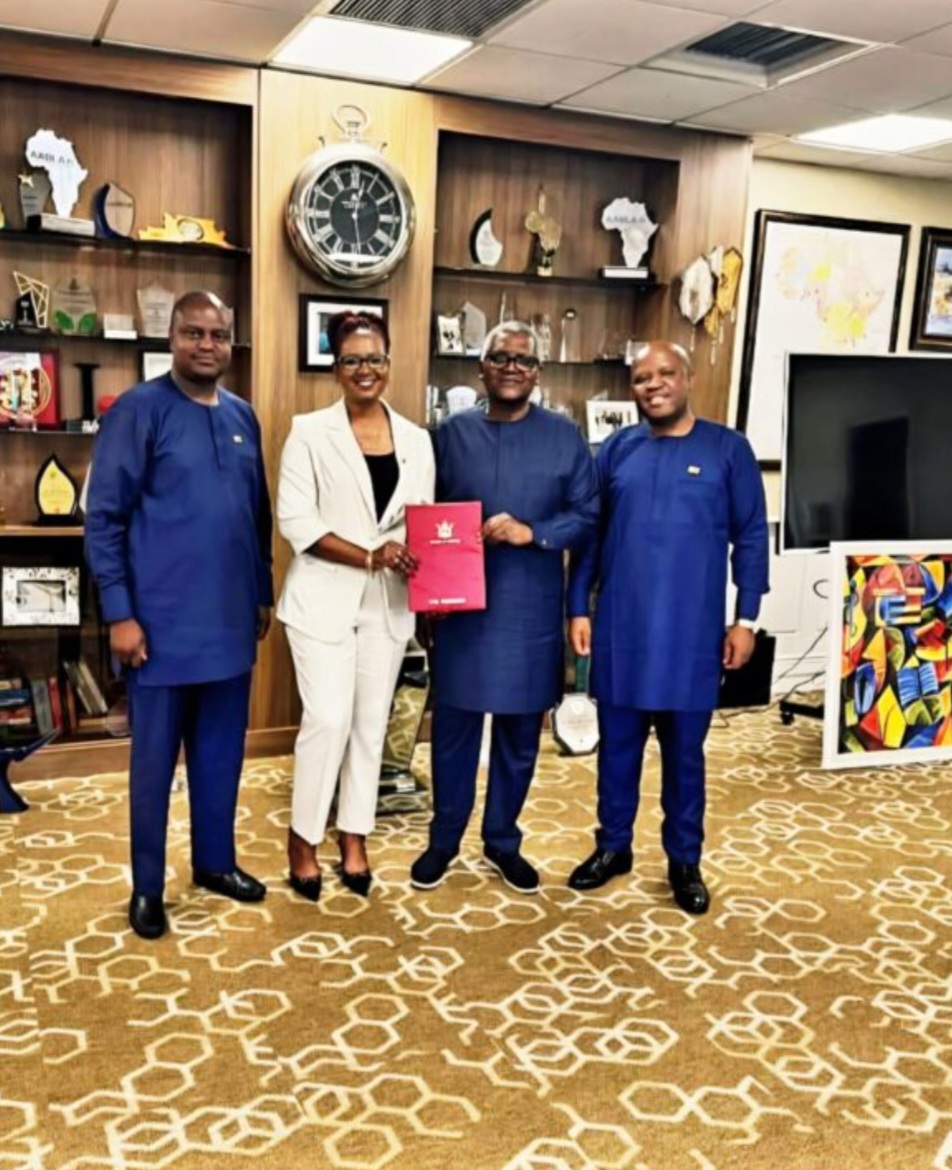
The breakthrough came via a quiet 16-month private campaign orchestrated by Bard Santner and its chief executive Senziwani Sikhosana alongside senior partner executives Tatenda Hungwe, Lucia Chingwaru, and Mahachi.
Capitalising on a networking window at the Afreximbank Annual Meetings in Abuja, the Bard Santner team aggressively pitched Zimbabwe’s renewed ease-of-doing-business reforms directly to Dangote.
Their persistence paid off.
Dangote returned to Zimbabwe to iron out a mega-deal valued at over US$1 billion. Under the structured roadmap, the capital will fund a state-of-the-art cement manufacturing plant, limestone quarries, coal mining operations, and a supporting power station.
As the Dangote Refinery in Lagos initiated its historic US$1.6 billion IPO across continental exchanges, Bard Santner was engineering financial mechanisms to ensure local investors can participate in the broader pan-African offering.
The mechanics of this public offering are meticulously engineered to balance institutional scale with micro-retail accessibility.
The public subscription opened on September 14 and is scheduled to close on October 13.
Shares are projected to formally begin trading on the NGX main board in November.
The refinery is offering 4.1 billion ordinary shares priced at ₦525 ($0.40) per share.
The core offering aims to secure ₦2.15 trillion (about US$1.63 billion), which could scale up to US$2.1 billion if the 30% greenshoe overallotment option is exercised.
The offer price pegs the total valuation of the Dangote Refinery between US$47 billion and US$49 billion.
To maximse inclusion, the minimum subscription threshold is set at a mere 10 shares (a baseline investment of ₦5 250 or US$4).
The offering comprises roughly a 3% stake in the company.
Dangote will maintain an overwhelming majority control of roughly 84.3% of the entity, while the state-backed Nigerian National Petroleum Company retains a capped 6.8% stake.
Building the world’s largest single-train oil refinery was a gruelling 10-year journey. Mega project delays, currency devaluations, and global supply chain shocks ballooned the initial US$9 billion budget to a final price tag of US$19 billion by the time it opened. Heavily leveraged with US$12 billion in syndicated debt, analysts long worried about the refinery’s capital structure.
However, 2026 has marked a dramatic financial turnaround.
While the asset posted a loss of US$476 million during its ramp-up phase in 2025, it swung violently into the black for the first half of 2026 — reporting an after-tax profit of US$1.82 billion on US$13.9 billion in revenue.
Supply disruptions stemming from the Iran war created a premium on refined petroleum products.
The refinery capitalised seamlessly on this, transforming into Western Europe’s largest external supplier of jet fuel.
The Nigerian government’s removal of legacy fuel subsidies allowed the refinery to sell directly to local marketers at import-parity pricing.
This untangled the asset from bureaucratic subsidy arrears and made its working capital highly bankable.
Dangote, who has investments across 17 African countries, plans to use the US$1.6 billion IPO proceeds to fund a massive US$14.3 billion expansion, giving the ordinary person — including vendors, drivers, cooks, and domestic workers — the opportunity to own a tangible stake in one of Africa’s most strategic industrial assets.
The strategic roadmap aims to double capacity to 1.4 million barrels per day by 2029, construct extensive petrochemical and grade-specific diesel units, and establish a new coastal distribution plant in Kenya to capture the East African market.
The broader ramifications of this IPO extend far beyond a standard corporate balance sheet.
Historically, localised wealth in emerging markets has been vulnerable to local currency depreciation.
Dangote intentionally structured this IPO to allow retail investors access to a business whose underlying revenues are largely dollar-linked, promising dividend payouts that act as a hedge against inflation.
Much like Saudi Aramco’s historic listing in 2019 transformed Middle Eastern capital structures, the Dangote listing fundamentally redefines the scale of the Nigerian Exchange.
It signals to global institutional funds that African bourses can host and sustain multi-billion-dollar liquidity events.
For decades, Nigeria suffered from a paradoxical economic curse — exporting crude oil only to import expensive, refined petroleum products.
This refinery already supplies 57% of Nigeria’s domestic fuel demand.
By scaling it further via public capital, the region transitions from an import-dependent zone to a net exporter of energy.
The synergy between Bard Santner’s advisory manoeuvres and regional interest in the IPO exposes three vital macroeconomic trends: The rise of industrial diplomacy.
Local advisory boutiques are replacing traditional bureaucratic diplomatic channels.
Bard Santner’s capacity to navigate complex policy environments and present structural guarantees directly to local investors and global titans highlights a maturing domestic financial services sector.
For a long time, Zimbabwe has battled negative international capital perceptions. Attracting Africa’s wealthiest individual acts as a powerful seal of approval.
It triggers a positive contagion effect, demonstrating to global asset managers that Zimbabwe’s investment climate and regulatory terrain is becoming predictable and secure enough for large-scale capital deployments.
The convergence of the Zimbabwean investment deal organised by Bard Santner with local interest in the Dangote IPO, handled by the same advisory firm in Harare, underscores a shifting paradigm toward a borderless financial ecosystem and watershed moment for the country’s investment landscape.