

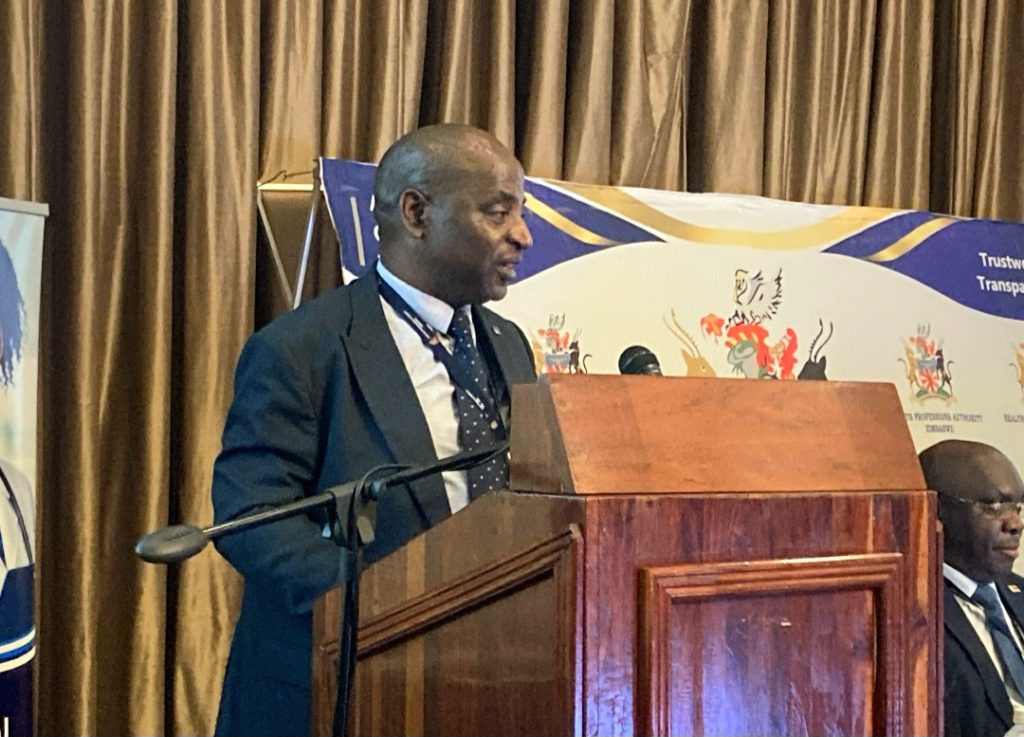
Dr Raphael Makota, Chitungwiza Central Hospital Chief Medical Officer
BY MUNYARADZI BLESSING DOMA
Health and Child Care Minister, Dr Douglas Mombeshora has called for a streamlined health regulatory system that protects the public, without creating bureaucratic bottlenecks that slow down innovation and development in the health sector.
Minister Mombeshora, who was represented by Chitungwiza Central Hospital Chief Medical Officer, Dr Raphael Makota, said regulation should be proactive, seamless and supportive of progress in healthcare.
He was speaking at the 2026 Health Professions Authority (HPA) Zimbabwe, Medical and Dental Practitioners Council and Medical Rehabilitation Practitioners Council joint Annual General Meeting held in Harare on Thursday.
The Minister said health regulation should not stand in the way of innovation, but should instead facilitate faster and more efficient delivery of healthcare services.
“In this new era of healthcare delivery, regulation can no longer be a bureaucratic bottleneck.
“It must operate as an enabler, a facilitator, of speed, innovation and ethical modernization – ensuring that our systems protect the public without slowing the pace of progress,” said Dr Mombeshora.
He added that regulators should stay ahead of developments in the health sector and ensure that regulations do not prohibit innovation.
“Regulation should be proactive as opposed to being reactive. You need to stay ahead of the trends in the healthcare space and come up with regulation that does not prohibit innovation,” he said.
Dr Mombeshora also called for a one-stop-shop approach to the registration of health facilities to reduce the number of offices that applicants have to visit.
“The Authority should take up its umbrella role and explore the one stop shop concept and reduce the number of offices one had to visit in order to register a health facility.”
His call comes as the HPA moves to address concerns around over-regulation and duplication of roles among health regulatory bodies.
Professor Joconiah Chirenda, HPA president
HPA president Professor Joconiah Chirenda speaking at the same AGM, said one of the complaints from health practitioners had been over-regulation, adding that the Authority’s new strategy seeks to address this through greater coordination.
“One of the recurrent complaints from practitioners has been over-regulation. This strategy seeks to address this through coordination of functions between the Authority and Councils.
“It will also look at other regulatory players to avoid duplication of roles,” said Prof Chirenda.
He said the HPA was also moving towards an umbrella approach aimed at standardising regulation across the different Councils.
The Authority’s 2026-2030 Strategic Plan includes digitalisation, use of existing provincial structures, research and development, strategic collaborations and the one-stop-shop concept.
Prof Chirenda said the use of provincial structures would help cut travel costs and improve turnaround times, while digitalisation would improve efficiency.
The HPA also plans to strengthen collaboration with other regulators and law enforcement agencies as part of its joint regulation approach.
Prof Chirenda said the Authority did not believe in silo regulation and was already working with bodies such as the Medicines Control Authority of Zimbabwe and the Police Drugs and Narcotics Unit.
And he said the Authority had also taken action against unregistered health facilities and bogus practitioners.
“Unregistered health facilities were closed through the police, bogus practitioners brought to book and at Council level, professional standards upheld,” he said.
Dr Mombeshora added that while regulation must facilitate progress, public safety and adherence to professional standards remained critical.
He commended the HPA for its enforcement work against unregistered facilities and bogus practices, saying institutional integrity, practitioner registration and adherence to clinical standards remained non-negotiable.
The Minister said the HPA and its Councils should work together to avoid duplication and “scope of practice wars”, while keeping the interests of citizens at the centre of their work.
“Our primary duty is to the citizen. With that central focus guiding our efforts, we can transition seamlessly from siloed operations to a collaborative, supportive regulatory framework,” he said.
Prof Chirenda said the Authority would continue to pursue innovative ways of maintaining its regulatory mandate while responding to changes in the operating environment.
He said the ultimate goal was to ensure that citizens received the right healthcare, at the right time, at the right facility and from the right person.