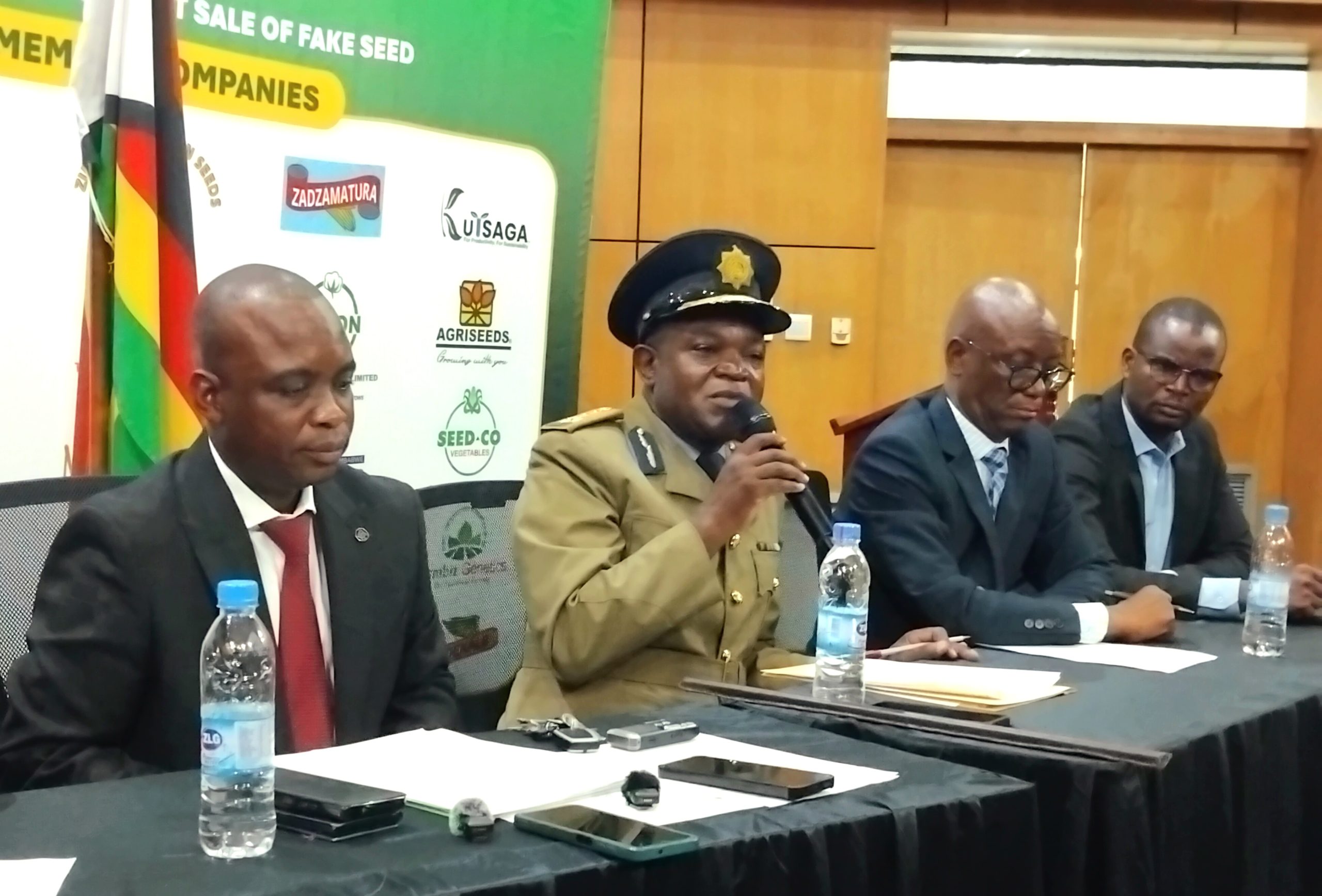
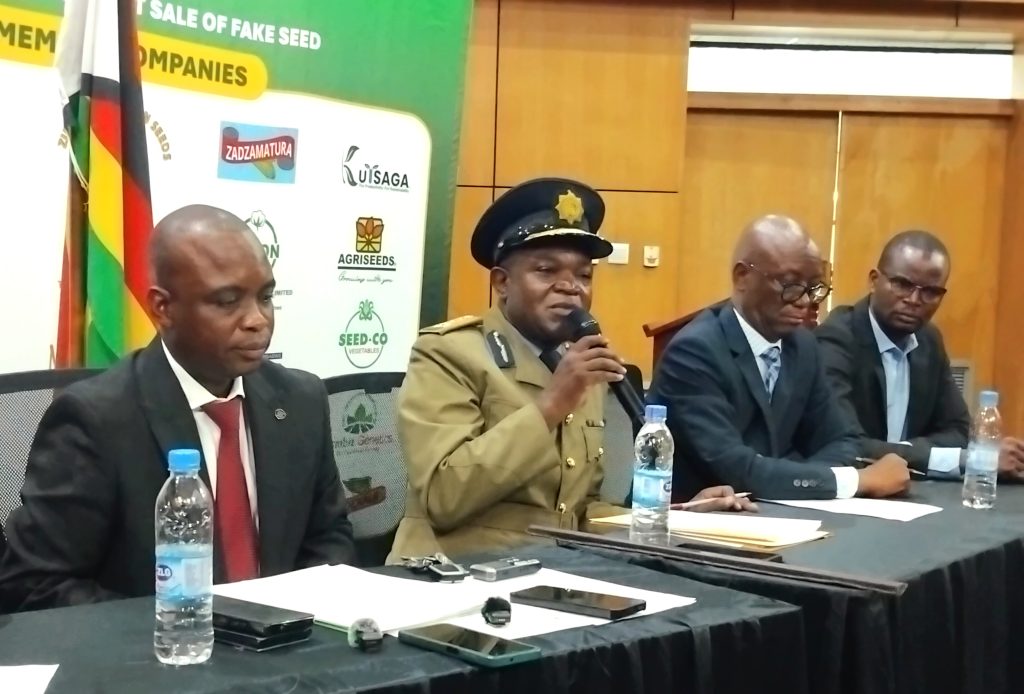
(from left) Edmore Mtetwa, Commissioner Paul Nyathi, Dr John Makoni and Talk Chinoda
BY MUNYARADZI BLESSING DOMA
The Ministry of Agriculture, Mechanisation and Water Resources Development working in collaboration with the Zimbabwe Republic Police (ZRP) and Zimbabwe Seed Association (ZAS) has intensified spot checks at agro-dealer outlets across the country, to clamp down on the sale of fake and counterfeit seed, warning farmers to buy from registered and reputable companies.
Head of the Seed Services Institute in the Ministry of Agriculture, Mechanisation and Water Resources Development, Edmore Mtetwa, said the inspections were targeting agro-dealers during the peak seed-selling period to ensure compliance with the country’s seed regulatory framework.
Mtetwa revealed this today (Thursday, November 26, 2026) in Harare, at the Zimbabwe Seed Association/ZRP/Seed Services Institute, press conference on the fight against fake and counterfeit seed in the country.
Mtetwa said the spot checks are meant to monitor compliance with regulations governing the sale and distribution of seed.
He added that the nationwide market surveillance operation, which started on October 5, 2026, would run until mid-December, depending on the market situation.
“The Ministry’s Seed Inspectorate has intensified market surveillance activities given that the country is now in the peak selling period for seed.
“We wish to remind farmers and the general public that they must purchase certified seed from registered agro-dealers only to avoid the risk of being duped by unscrupulous dealers selling fake seed,” he said.
Mtetwa said the spot checks were also aimed at ensuring seed traceability through the country’s seed certification and quality assurance system.
He urged farmers to verify whether agro-dealers were registered, saying they had the right to request proof of registration or licensing, which should ordinarily be displayed at the outlets.
“Section 8 of the Seed Act (Chapter 19:13) stipulates that, ‘no person shall sell seed unless registered as a seed seller.”
Mtetwa said the licensing of seed sellers enables the Ministry to assess their capacity to handle and safely store certified seed while preventing the distribution of counterfeit products.
He warned that unscrupulous dealers risked arrest and prosecution, with possible penalties including loss of licences, fines, compensation to affected farmers and imprisonment.
Commissioner Paul Nyathi, ZRP Spokesperson said the police had launched a nationwide operation in partnership to dismantle syndicates involved in the manufacture, distribution and sale of counterfeit seed ahead of the 2026/2027 agricultural season.
He said investigations had revealed that fake seed was largely being sold through informal markets and hardware shops in different parts of the country.
Commissioner Nyathi said some unscrupulous traders were imitating reputable seed companies’ brand names, logos and packaging materials to deceive unsuspecting farmers.
He said the counterfeit products were often sold at significantly lower prices than genuine certified seed, exposing farmers to financial losses and poor agricultural yields.
The police also warned that individuals, traders and syndicates involved in manufacturing, packaging, distributing and selling counterfeit seed would face the full force of the law.
Commissioner Nyathi said those caught would be brought to book in accordance with the Seed Act and other applicable laws.
He further indicated that the police would name and shame individuals and outlets found engaging in the illegal trade as part of efforts to expose the culprits and protect farmers.
The police urged farmers to remain vigilant when purchasing agricultural inputs and encouraged members of the public to provide information that could assist in identifying individuals and outlets involved in selling counterfeit seed.
“The operation seeks to protect farmers from unscrupulous traders, safeguard legitimate agricultural businesses and ensure that farmers have access to genuine, certified maize seed for the forthcoming farming season,” said Commissioner Nyathi.
Meanwhile, ZSA Chairman Dr John Makoni said farmers needed to be particularly careful this season given predictions of below-normal rainfall, which made the choice of seed critical.
He said farmers should buy seed whose performance met their expectations, particularly in terms of germination and maturity periods under rain-fed conditions.
Dr Makoni said poor-quality seed and unsuitable varieties could further undermine farmers’ chances of achieving good yields during the anticipated El Nino season.
He added that seed produced or marketed by ZSA members was processed and distributed in accordance with laid-down regulations and procedures to guarantee quality.
“Good quality seed from ZSA members is distributed across the country through a network of reliable/reputable and registered agro-dealer network- this season most ZSA members have publicised stockists of their seed.
“Seed from ZSA members is not sold in a cup by the roadside. Farmers are urged to be familiar with seed packaging of your desired brand.
“You can spot fake seed by suspicious packaging, spelling errors on the package or label, errors on the seed company logo, the colour shade of the dye on the seed and of cause-cheap price.
“To protect consumers of seed, some ZSA members now have added authentication features on their seed bags and are raising awareness of such features,” said Dr Makoni.
A member of the ZSA Executive Committee, Talk Chinoda, said the fight against counterfeit seed required collective responsibility from all stakeholders in the agricultural sector.
He said collaboration between the police, Seed Services Institute and the seed industry was critical in strengthening law enforcement, regulatory oversight, industry cooperation and public awareness.
Chinoda said seed was the foundation of agriculture, with its quality having a direct bearing on productivity, agricultural output, livelihoods and national food security.
“The fight against counterfeit seed is not the responsibility of one institution alone. It requires a collective commitment from seed companies, agro-dealers, farmers, law enforcement agencies, regulators and the media,” he said.
Authorities also warned against the unauthorised importation of seed, saying illegally imported varieties could introduce pests and diseases, while varieties not evaluated under Zimbabwe’s agro-ecological conditions could expose farmers to production losses.
Members of the public are urged to report suspected manufacturers, distributors and sellers of counterfeit maize seed at any nearest police station or through the ZRP National Complaints Desk on 0242 703 631 or via WhatsApp on 0712 800 197 and Rapid Response Reporting Hotlines for Seed Services Inspectorate: 0242 709712/ 0242 791223/ 0773647277/ 0772650327