

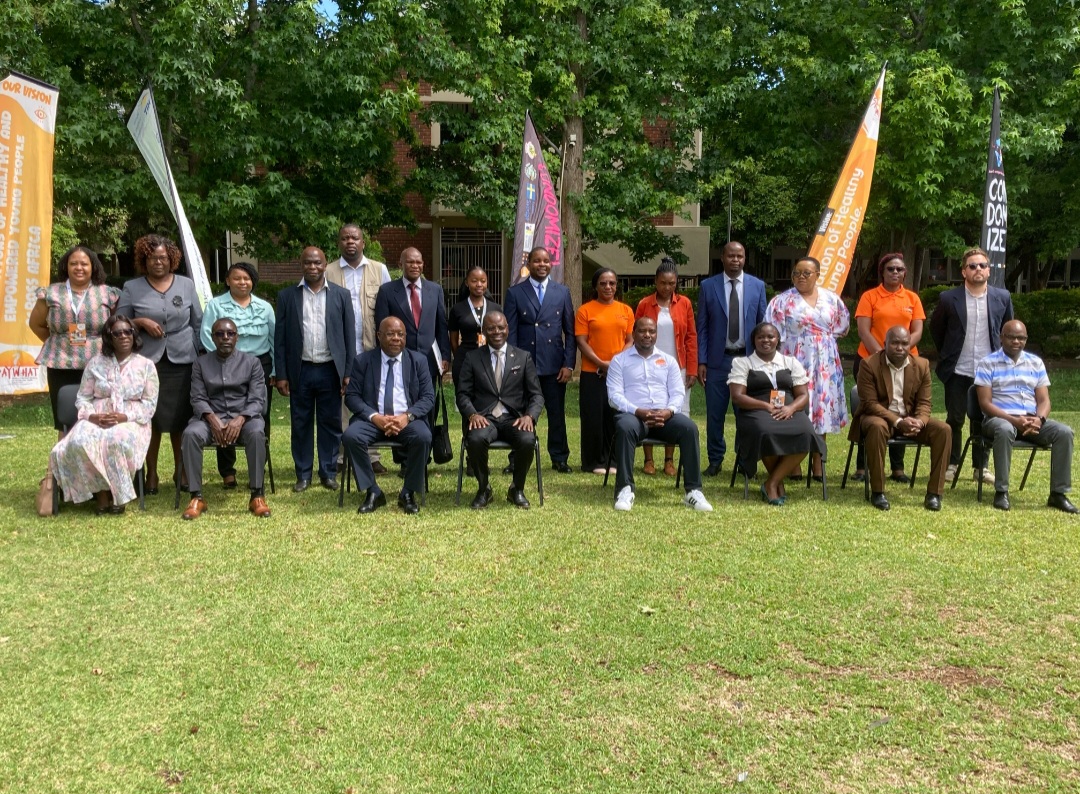
Some of the officials who attended Day 2 of the 15th National Students Conference
BY MUNYARADZI BLESSING DOMA
Students and youth issues transcend national boundaries, therefore there is need for regional collaborations to ensure their full empowerment, Permanent Secretary in the Ministry of Youth Empowerment, Development and Vocational Training, Solomon Mhlanga has said.
Mhlanga said this yesterday (Tuesday), the second day 1 of the two-day 15th National Students Conference, which was held at the Harare Institute of Technology (HIT).
Running under the theme “A crystal vision for students’ health and education,” the conference which was organised by SAYWHAT and with support from various partners, was attended by several local and Southern African participants.
“As we celebrate this crystal vision, I am pleased that this gathering has transcended national boundaries.
“The presence of young people from partner countries Botswana, Malawi, Namibia, and Zambia reminds us that the challenges students and youth face are not confined by borders.
“They are regional challenges that require regional solidarity and shared solutions.
“Your presence here enriches this dialogue and strengthens our collective commitment to youth empowerment across Southern Africa,” said Mhlanga.
He added that his ministry stands with Zimbabwean and SADC Region students, “working together towards a common vision of health, education, dignity and opportunity.”
He commended SAYWHAT for the conference, saying they are clearly geared towards operationalizing the National Youth Empowerment Strategy which was launched recently by President Mnangagwa.
“Your focus on building a healthy, youth population is greatly appreciated.
“We are committed to addressing the silent crisis affecting our campuses and communities for improved health and education outcomes where every young person can learn and live without fear.”
He added all young people who spoke had shown so much courage in articulating challenge they face and the aspirations they hold for digital dignity and improved mental health for young people is inspiring.
“I am reminded, yet again, that our youth are not passive recipients of policy, but architectures of Zimbabwe’s future.
“Your efforts to demand better health and education outcomes will not only benefit you, but generations of young people to come.
“Most importantly, the discourse today resonates deeply with our national Vision 2030 of becoming an upper-middle-income country.
“It also resonates with the National Development Strategy, National Development Strategy 2, which will be moving in from 2026 to 2030, as well as the Global Sustainable Development Goals.
“You have demonstrated that you are co-creators of Zimbabwe’s future.
“Your energy, creativity, and resilience are the foundation of national transformation.”
Mhlanga added that his ministry firmly believes in digital dignity and ensuring safe and equitable access to technology as well as protecting young people from online harm.
“We understand the correlation that exists between digital dignity, gender-based violence, drug and substance abuse and mental health.
“We reaffirm our commitment to working with you to address these issues.
“The Ministry of Youth Empowerment, Development and Vocational Training is strengthening vocational training programs to equip young people across the board with skills for a dynamic economy.
“We are collaborating with other ministries to integrate mental health services into youth programs and expand access to mental health services.”
He further revealed that they are also advancing digital literacy initiatives to ensure that technology becomes a tool for empowerment and not exploitation.
And he added that the ministry remains steadfast in supporting the fight against gender-based violence, aligning with regional and global strategies.
“Beyond these, we pledge to explore policy reforms and partnerships that amplify student-led innovations and research.
“Your voices will inform these actions and our mandate is clear to unlock the potential of every young person in Zimbabwe to protect your well-being as you pursue your dreams, your education and your contributions to our nation’s development.
“But our government cannot do this alone.
“The challenges which you have outlined require collective responsibility.
“Development partners, civil society, the private sector, to join hands with us.
“Let us invest in youth-led solutions scaling these innovations that are coming up, and creating safe, inclusive spaces for learning and growth.”
Harare Institute of Technology Pro Vice Chancellor, Willard Gwarimbo said the conference was testament that student voices can influence national discourse on health education and gender equality.
He added that the conference also shows that students are no longer mere recipients of knowledge but they are also innovators and partners in national development.
“Their (students) well-being, mental social and academic, is fundamental to driving industrialization in technological growth.
“We must acknowledge the pressing challenge of drug and substance abuse which continues to destroy young lives and undermine national productivity activity.
“This crisis demands a coordinated response involving prevention rehabilitation community engagement and strong policy support.
“This conference provides a timely forum for generating practical solutions to the government institutions and development partners,” said Gwarimbo.
He added that it was important to listen to the concerns and aspirations of students and act decisively, creating safe inclusive and supporting the learning environments.
Canada Ambassador to Zimbabwe, Adler Aristilde, echoed similar sentiments saying the conference was timely as it coincided with commemorations of the International Day for the Elimination of Violence Against Women, launch of the 16 Days of Activism Against Gender-Based Violence.
“We reaffirm on this day a shared vision, a Zimbabwe and world where every person, every young person, is healthy and safe.”
He added: “the urgency of this vision is clear if we consider these realities and some statistics we will likely hear a lot during the 16 days. “One in three women in Zimbabwe experiences physical violence, one in four experiences sexual violence. “Sexual harassment remains widespread in colleges, yet reporting mechanisms are often absent.
“Mental health remains rising, over 35 percent of university students face depression or anxiety, but only 16 percent access mental health services while economic stress and substance abuse compound the crisis.
“Ninety-percent of students report a lack of institutional mental health support.”
He reiterated his country’s commitment to address Gender-based violence, mental health challenges and digital harm.
“Addressing them holistically is essential for student well-being and for national development.
“This conference, celebrating its crystal jubilee, symbolizes resilience and clarity in advocacy.
“Your voices shine through challenges to inspire transformation,” added Ambassador Aristilde.
He added: “Canada stands firmly for gender equality and human rights and commits to continue working with Zimbabwean partners to create safe spaces, advance legal reforms, and support youth-led initiatives tackling gender-based violence, mental health and sexual violence.
“Canada stands firmly for gender equality and digital safety and initiatives that address women and girls as well as men and boys.
“Canada has partnered with civil society to develop and rule out the model and benchmarking policy on anti-sexual harassment for universities and colleges because harassment has no place in running institutions.
“We hope to improve access to sexual and reproductive health services for thousands of women and young people in Zimbabwe, empowering them to make informed decisions about their bodies and their futures.
“Canada’s engagement goes beyond social development, trade and economic growth are central to our partnership with Zimbabwe and Southern Africa.
“We believe that inclusive economic development in which women and youth participate.
“We believe that inclusive economic development in which women and youth participate fully is essential for sustainable progress.”
SAYWHAT Executive Director, Jimmy Wilford said the platform is meant to continually provide guidance and leadership to the students.
“What keeps us going right now is the future.
“How can we ensure that we provide this much correct information to the young people through this conference so that these young people can make informed decisions about their lives.
“This strength lies in collective resilience, solving challenges that no single strength could overcome alone,” said Wilford.
He said the Web for Life gives young women a safe space to confront layers of vulnerabilities including gender-based violence, sexual harassment, and limited access to sexual and reproductive health services.
And through the National Student Conference, young women are given an opportunity to face those realities, he said.
Wilford added that since inception, they believed that students are supposed to be given a platform for them to meet, to discuss, to dialogue, to reflect, to provide leadership on what might turn out to be something that can transform their realities.
“What keeps us going right now is the future. How can we ensure that we provide as much correct information to the young people through this conference so that these young people can make informed decisions about their lives?”
He added that through the various researches, they hope to get the Parliamentarians to influence policymaking.
Wilford reiterated that the platform remains very relevant, adding: “let the National Students’ Conference, the 15th edition, not be a turning point but a new commitment to climate, resilience and collective impact.
“Because if the last 14 editions have taught us anything, it is this.
“When students give partners their support, transformation is inevitable,” he added.


