BY MUNYARADZI BLESSING DOMA
So they say all good things must come to an end and sadly so, the Love Shouldn’t Hurt, the anti-gender based violence programme has now come to an end.
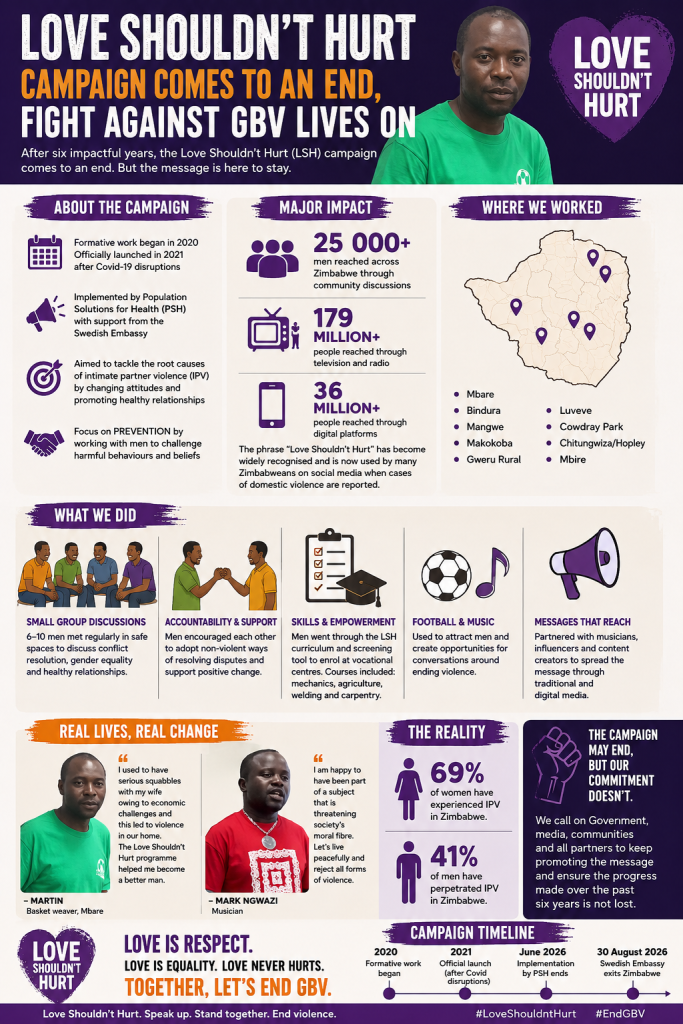
The LSH campaign which was being implemented by the Population Solutions for Health (PSH) with support from the Swedish Embassy, has ended after six years.
It is reported that the formative work for this campaign was in 2020 but it was only launched in 2021, owing to disruptions caused by Covid.
The campaign implementation by PSH ended in June (last month), however the Swedish Embassy will leave the country by August 30.
According to the Zimbabwe Republic Police, at least 13 838 cases of sexual offences and aggravated domestic violence were recorded across the country in 2024.
The Zimbabwe Demographic and Health Survey 2023–2024 also shows that 27 percent of women aged 15 to 49 have experienced physical violence, while nine percent have experienced sexual violence in their lifetime.
It was announced that the decision to stop the LSH campaign was not linked to poor implementation or mismanagement, but was a result of the Swedish Embassy redirecting its priorities to respond to emerging security concerns in their region.
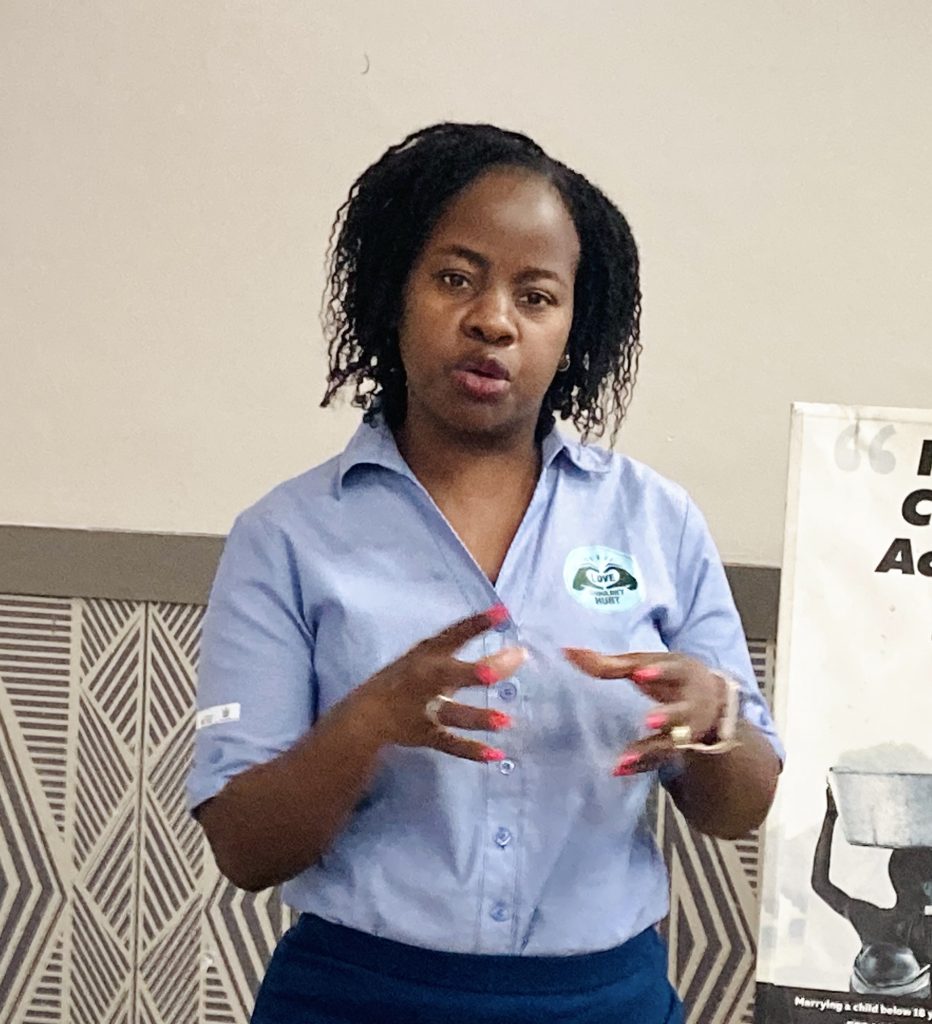
Varaidzo Clarah Mabhunu-Maniwa, Marketing Executive at PSH
Varaidzo Clarah Mabhunu-Maniwa, Marketing Executive at PSH, revealed that the campaign reached more than 25 000 men across Zimbabwe through community discussions aimed at changing attitudes and preventing GBV.
Mabhunu-Maniwa added that it (campaign) sought to tackle the root causes of intimate partner violence (IPV), by encouraging men to rethink their understanding of love and relationships.
She emphasized that unlike other GBV interventions that focus on helping survivors after violence has occurred, the Love Shouldn’t Hurt campaign focused on prevention by working directly with men to address behaviours and beliefs that fuel violence.
“Our goal has always been to contribute towards reducing gender-based violence against women and girls, including child marriages in Zimbabwe.
“We wanted to understand what triggers violence and prevent it before it happens. “We realised that if we wanted to end GBV, we had to work with the perpetrators and encourage positive behaviour change,” said Mabhunu-Maniwa.
LSH campaign explainer
The campaign was first rolled out in Mbare, Bindura, Mangwe and Makokoba before expanding to additional districts, including Gweru Rural, Luveve, Cowdray Park, Chitungwiza/Hopley and Mbire.
Mabhunu-Maniwa added that one of the campaign’s major activities involved small group discussions where between six and 10 men met regularly in safe spaces to openly discuss conflict resolution, gender equality and healthy relationships.
The men were encouraged to hold each other accountable and support one another in adopting non-violent ways of resolving disputes.
And it was added that the men had to go through a LSH curriculum and a screening tool, to be enrolled at a vocational centre.
Some of the main courses included mechanics, agriculture, welding and also carpentry to improve their livelihoods, while football and music activities were used to attract men and create opportunities for conversations around ending violence.
The LSH campaign also partnered with musicians, influencers and content creators to spread its message through traditional and digital media.
“The campaign achieved more than 179 million people through television and radio, while digital platforms recorded over 36 million people.
“One of the biggest successes of the campaign was that the phrase ‘Love Shouldn’t Hurt’ has become widely recognised, with many Zimbabweans now using it on social media whenever cases of domestic violence are reported.
“We are proud that people have internalised the message. When incidents of violence are shared online, many people now simply respond by saying ‘Love Shouldn’t Hurt’. That shows the message has resonated with communities,” said Mabhunu-Maniwa.
Martin, a basket weaver from Mbare, said he used to have serious squabbles with his wife owing to economic challenges and this led to violence in their home.
He said when got to know about the Love Shouldn’t Hurt programme, he was helped by other champions and after receiving adequate counselling, he became a better man.
Martin’s wife Emerina, also spoke of how the programme had helped her husband become a better person.
Talented musician, Mark Ngwazi who featured on the anti-GBV song, Love Shouldn’t Hurt-Strong Enough, encouraged people to live peacefully and reject all forms of violence.
He revealed that he was happy to have been part of this subject which is threatening society’s moral fibre.
The country continues to record high levels of intimate partner violence, with experts noting that many women experience violence at the hands of partners who should be protecting them.
It is reported that 69 percent of women have experienced IPV in Zimbabwe, while 41 percent of men have perpetrated it.
There are numerous calls for hope that despite the end of donor funding, government ministries, media organisations and other partners will continue promoting the campaign’s message to ensure progress made over the past six years is not lost.