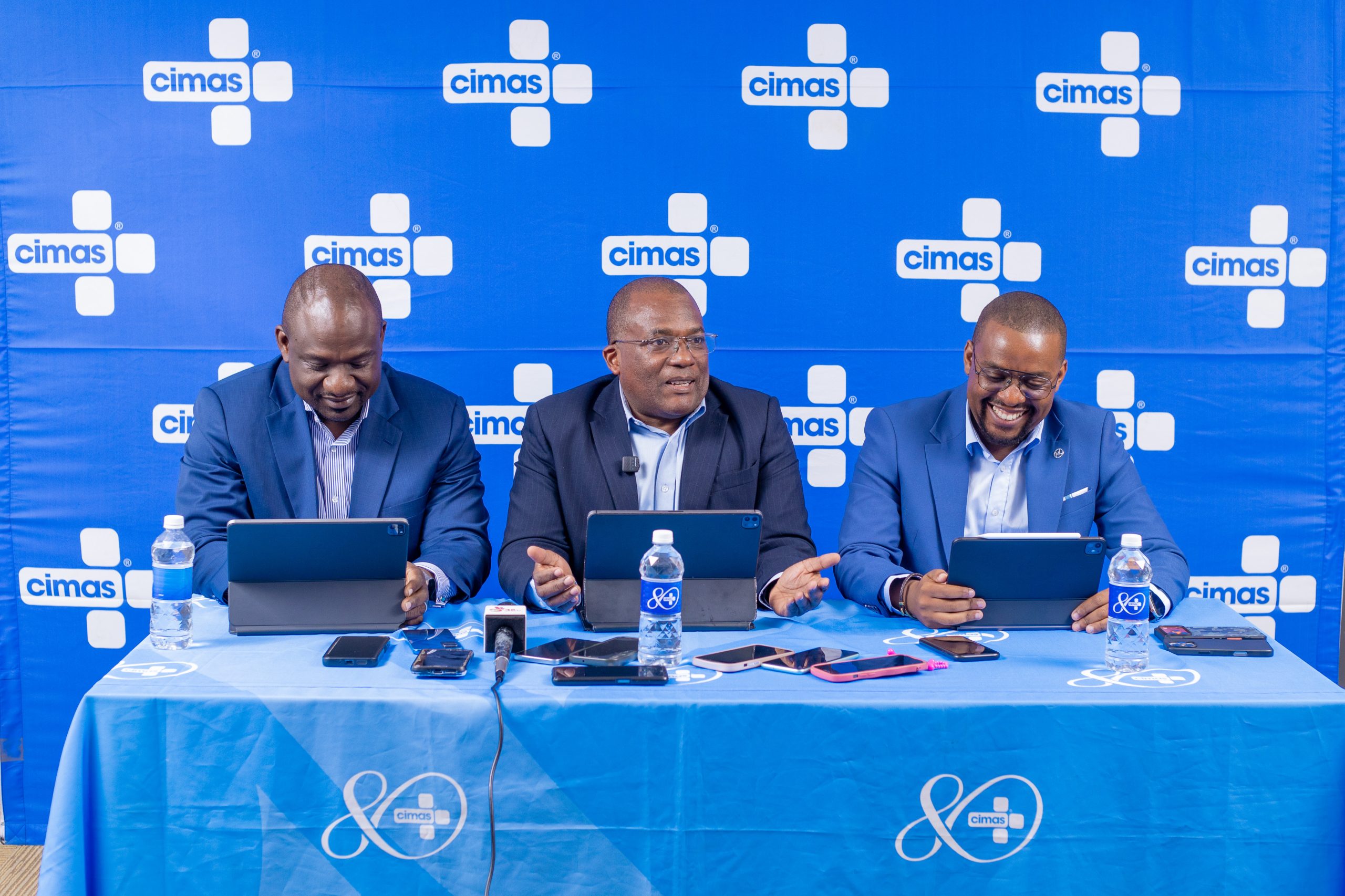
Cimas Health Group’s Chief Executive Officer, Vuli Ndlovu (centre) flanked by Cimas Health Group’s Chief Information Officer, Foster Akaketwa (left) and Cimas Health Group’s Chief Marketing Officer Manatsa Gaka, at the Cimas Healthathon 3.0 Launch Press Conference.(pic by Watson Ofumeli)
BY MUNYARADZI BLESSING DOMA
Home-grown innovations are key to strengthening Zimbabwe’s healthcare system, Cimas Health Group’s Chief Executive Officer Vuli Ndlovu has said.
Ndlovu said while the healthcare sector may face challenges, it’s high time serious action is taken for the country to harness local innovations as a sustainable pathway to improving access, affordability and quality of services.
Ndlovu revealed this on Wednesday afternoon (June 3, 2026) as Cimas Health Group launched the Cimas Healthathon 3.0 at their Head Office in Harare.
According to the World Health Organisation (WHO), a healthathon, often used interchangeably with Health Hackathon, is an innovation event which brings together students, developers, health professionals and entrepreneurs to rapidly design, prototype, and pitch digital IT solutions for real-world healthcare challenges.
“Can the Healthathon 3.0 be a vehicle for change? I think so, that’s why we are here to launch it. And we really believe it must be more than a competition.
“It’s a national platform for ideas, for talent, for collaboration, and for problem solving. It is where we are inviting Zimbabwean innovators to reimagine the future of healthcare. I repeat, it’s more than a competition.
“It must lead to impact, it must lead to addressing some of the problems that we are talking about. The competition side can be fun, but let’s look at the impact side. I think it’s a source of inspiration.
“We think the solutions lie out there and we forget that some of the most powerful solutions will come from us, amongst us.
“So we are really hopeful that this type of an exercise, this kind of a Healthathon, will get us thinking about all those things.
“So home-grown is very important for us, from us. Practical solutions, scalable solutions, scalable innovations that speak to our local realities, while we can also scale them globally,” said Ndlovu.
Cimas Health Group CEO, Vuli Ndlovu addresses the media
He added: “I think we are looking for solutions with imaginations, but also solutions with substance.
“Ideas that are practicable, that are scalable, technically sound, and capable of really having an impact in the lives of Zimbabweans.
“And it must be innovation that drives, improves access, drives efficiency, strengthens prevention, and enhances patient experience. “But also builds a more inclusive and sustainable healthcare system.”
He reiterated that innovation is changing how people access care, how systems operate, how data is used and how patients experience healthcare, hence Zimbabwe cannot be left behind.
“I think we got a bit of that during Covid when telehealth really took off in a good way.
“I believe that Zimbabwe cannot afford to be left behind, not because we just want to jump onto the bandwagon, but because we have got real issues to deal with.
“Our healthcare sector faces real and urgent challenges. Access is not as good as we would like it to be, affordability is a continuing cry.
“We operate a medical aid and daily we seem to be chasing our tail in terms of shortfalls and co-payments. And these are real problems that we need to deal with.
“Fragmented systems, delayed service delivery, the way our care is coordinated around the system, where you have to go from point A to point B to point C to get anything done,” said Ndlovu.
He revealed that unlike last year when the competition was limited to students from tertiary institutions, for this third edition, participation is also open to start-ups, innovation hubs and developers among others.
The competition, which is running under the theme “Reimagining Healthcare Through Disruptive Innovation”, will officially open on June 22 and close on July 12, with finals set for August 28.
The first prize winners will walk away with US$3,500, second place US$2,000 and US$1,500 for third place.
Ndlovu said the real opportunity goes beyond the prize money, as participants will also have the chance to gain visibility, to receive mentorship, to build partnerships and to pilot their ideas with Cimas Health Group.
“We want the health platform to become a movement, a space where we can nurture ideas, partnerships are built, and solutions are brought to life,” he said.
He further revealed that the thrust now is towards preventive health, hence there is a need for a more concerted drive towards preventive health management.
“So these are not abstract problems, they are real problems that we face and I always say health is emotive, and we face it in our communities, we face these problems in our families.
“We also believe that these challenges present an opportunity, an opportunity to rethink our healthcare, to innovate broadly and to create practical solutions that can improve lives.
“That is why we continue to invest in digital health innovation as part of our broader mission to inspire healthier communities,” added Ndlovu.
He added that this year’s approach is quite exciting and unlike previous editions, where they were restricted by predetermined categories, they have just one broad category under the theme: “Reimagining Healthcare Through Disruptive Innovation.”
And Ndlovu said this year they are giving participants freedom to think boldly, creatively and expansively about what healthcare can become.
Cimas Health Group’s Chief Information Officer, Foster Akaketwa said they had raised the bar for what health tech innovation can look like in the country.
He also revealed that the eligibility and participation guidelines for the Healthathon 3.0 are designed to ensure a fair, innovative and impactful challenge.
“So, we have opened up the participation to everybody who is in the innovation space, the start-up community, as well as all the youngsters who would want to explore a career in this space, because we are going to give them the room to participate in the environment within Cimas Health Group to be able to make a difference.
“In terms of the recommended composition of the teams, each team should consist of a minimum of three and a maximum of five members.
“To inspire more disciplinary collaboration and innovation, each participating team is encouraged to include members with diverse skill sets and expertise,” he said.
Akaketwa added that this criteria was deliberate, because they believe a three-member team can carry the skills that will deliver maximum value, because one can be a domain expert, the other can be a technical member focused on the technology side of things and the other third member can also focus on the implementation and business aspects of the innovation.
Akaketwa said they said a maximum of five, because they believe that’s the number able to deliver the impact.
“Interested participants will be required to submit applications through an online application platform, after which the top 20 teams will be shortlisted based on the established screening criteria and evaluation and a further screening will be done so that we have the last six standing teams that will then be invited to the final.
“Teams are allowed to choose their own problem area, but must show why the problem is material, and why it affects or why it will make an impact in the community that we serve.
“The selected teams will then proceed to an orientation and briefing session, where they will be guided on the rules of participation, judging criteria, prototype development expectations, intellectual property and the data protection requirements, as well as the Demo Day presentation guidelines.”
He added that to qualify for participation, proposed solutions must directly address challenges within the Zimbabwean healthcare ecosystem and demonstrate practical relevance to the local healthcare environment.
And teams must also exhibit strong technical capacity to develop a functional prototype within the stipulated programme timeline.
Speaking on Healthathon 2.0 winners, Akaketwa said their projects are at “various stages, some of them commercialisation, some of them we have worked with the innovators to incorporate some of the ideas into the platforms that we already use.”
Cimas Health Group’s Chief Marketing Officer Manatsa Gaka said innovation is very important to the group, as it is not just a passion, but “it’s part of our values, it’s also part of our purpose.”
Gaka added: “and embedded within it, we are there to inspire other communities every single day.
“So, the Healthathon 3.0 is therefore a statement of intent of what we would like to do for the future.”