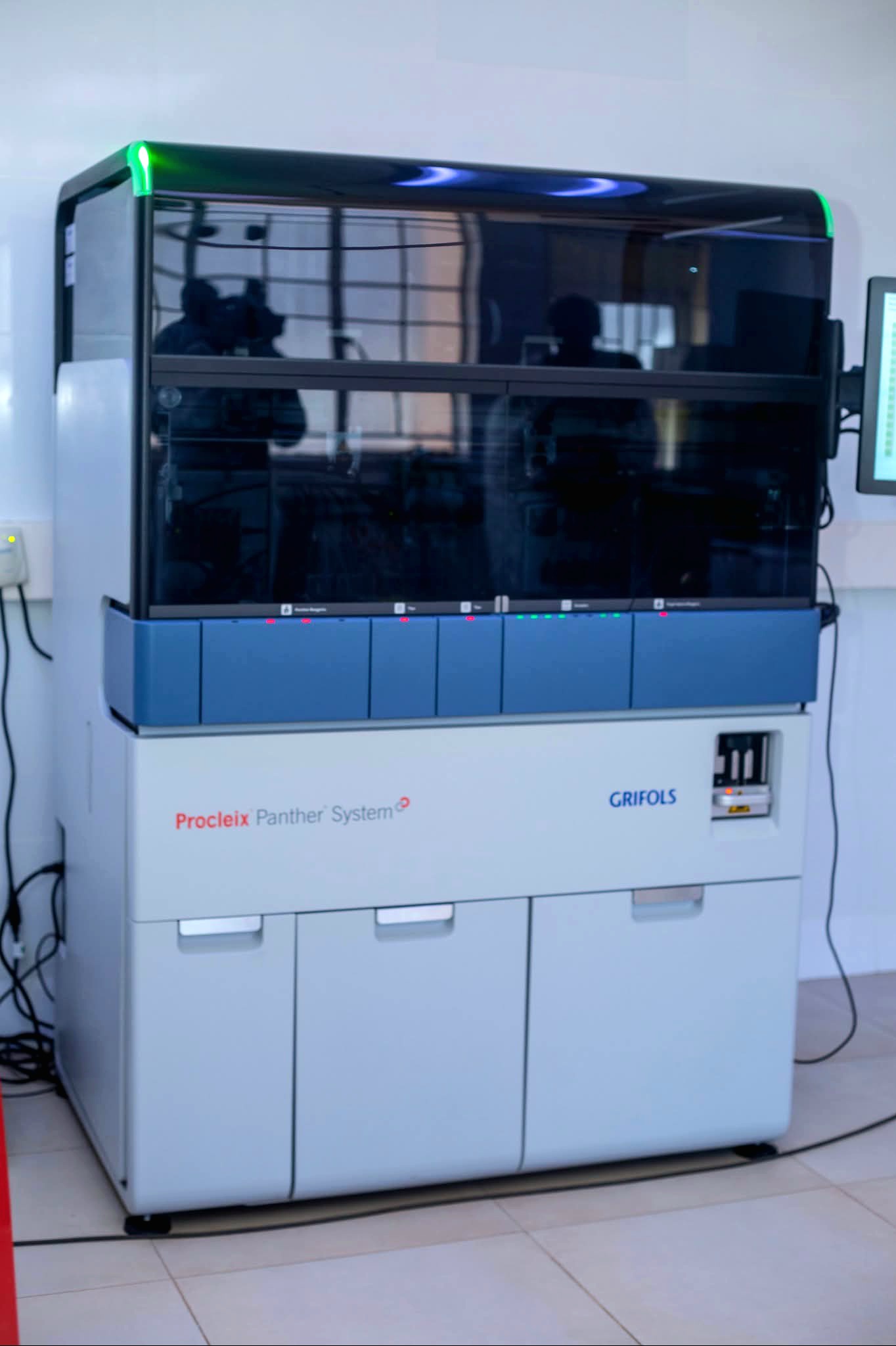

Minister of Health and Child Care, Dr Douglas Mombeshora (centre) cuts the ribbon at the commissioning of Nucleic Acid Testing machine at National Blood Service Zimbabwe headquarters, while flanked by National AIDS Council CEO Dr Bernard Madzima (left) and NBSZ CEO Lucy Marowa. Pic by Daphne Machiri
BY MUNYARADZI BLESSING DOMA
The Nucleic Acid Testing (NAT) machine which was handed over to the National Blood Service Zimbabwe (NBSZ) by the National AIDS Council (NAC), is set to enhance the former’s operations, as it will conduct 1 000 tests per 24 hours.
The NAT machine, was commissioned by the Minister of Health and Child Care, Dr Douglas Mombeshora at NBSZ headquarters on Thursday.
In an interview at the commissioning, Chief Executive Officer of NBSZ, Lucy Marowa said the machine is not replacing the machines they have always but, will enhance efficiency.
“Total throughput is 1,000 tests, not samples, but 1,000 tests per 24 hours of continuous running.
“So it (machine) is very fast, it’s very robust, and it can easily handle the workload that we have at National Blood Service Zimbabwe,” said Marowa in an interview with this reporter.
She added that the system was an enhancement to blood safety because it adds to the already existing serology testing platforms that they have.
Added Marowa: “with nucleic acid testing, we are looking for the presence of viral DNA or RNA within blood.
“And this clearly identifies the presence of a virus or any organism which has that particular DNA within the system.
“This is an extremely sensitive and highly specific machine; with sensitivity, it means that it can pick even the smallest bit of infectious material that is in blood, which other serology systems would ordinarily miss because of the localization.
“With specificity, it means that it is highly accurate, such that it does not mix up or cause a wrong, it doesn’t cause the picking up of what we call false positives.”
She added that in order to enhance blood safety, the nucleic acid plus the already existing serology systems together help to reduce the window period risk or the residual window period risk in donated blood.
“For now, we estimate our window period risk to be at three months, but with the combination of serology plus nucleic acid testing, we reduce that to around two weeks.
“That’s because the machine itself can pick up viral DNA in blood within 48 to 72 hours in some cases, depending on the actual type of virus that is in there.
“So when you combine that with the risk modelling that we have for our donors, it means that we significantly shorten the window period risk.
“That opens up the donation pool, meaning that we can venture into other areas or other demographics of donors we would ordinarily not use,” added Marowa.
Marowa further emphasized that the machine is quite robust and very fast.
“So when you load the machine fully and it starts running, the first results should come out with at around three and a half hours.
“Meaning that when we are testing donated blood, we test for three markers, Hepatitis B, Hepatitis C and HIV,” said Marowa.
She added that the machine is a national milestone that reflects their shared commitment to safeguard the lives of the citizenry.
Minister Mombeshora said commissioning of the machine demonstrates the country’s readiness to harness scientific innovation in strengthening the overall safety and resilience of the health system.
“Blood is a unique and irreplaceable medicine, it cannot be manufactured, it must be freely and voluntarily donated.
“Because of its immense value, it must be safeguarded through the highest standards of science, quality and care.
“Today, with the introduction of nucleic acid testing, Zimbabwe takes a decisive step forward in ensuring that every unit of blood transfused in our health facilities meets the highest possible standards of safety that modern technology can provide,” said Minister Mombeshora.
He added that for many years, the country has relied on serological screening to detect transmissible infections, a system that has served the country well due to the unwavering dedication of laboratory scientists, clinicians and the National Blood Service of Zimbabwe.
“As a result, our national blood program remains among the safest globally, and we take pride in having been one of the first nations worldwide to introduce routine HIV screening of donated blood as early as 1921.”
He added that HIV infections occurring within 48 to 72 hours can now be identified long before conventional methods would detect them.
“Likewise Hepatitis B and Hepatitis C can be detected within days of exposure while the enhanced sensitivity of this system ensures that even the smallest traces of viral material are reliably identified.
“Ladies and gentlemen let me emphasize that this is not a replacement of existing systems but a strategic enhancement.
“Zimbabwe now embraces a layered approach to blood safety integrating robust donor selection, advanced fourth generation serology, nucleic acid testing and stringent quality management.
“Through this comprehensive system, our country aligns with international best practices ensuring that every unit of blood meets the highest global standards of safety,” added the Minister.
He also emphasized that the introduction of nucleic acid testing is a game changer as it strengthens HIV prevention, reinforces public confidence, aligns Zimbabwe with global standards and enhances national resilience in times of crisis or emergency.
Minister Mombeshora also applauding NAC for the support to procure the NAT machine and Grifols represented locally by Cluster Diagnostics for the installation, validation and training that ensured the successful implementation of the system.
And he also applauded the Postal and Telecommunications Regulatory Authority of Zimbabwe (POTRAZ) for the donation of blood bags valued at US$15 000.
The Chief Executive Officer of NAC, Dr Bernard Madzima said for them, safe blood is a cornerstone of public health.
“At NAC, we take our mandate seriously, that of coordinating the HIV response.
“And we work with relevant stakeholders, tapping into their comparative advantage as far as again, their expertise is concerned.
“And ensure that there is a holistic approach to HIV prevention and treatment services.
“This is what we call value for money, so it was a no-brainer for us really, both from the management perspective and from the board perspective.
“When NBS approached us requesting for support to make sure that they have this equipment, the nucleic acid testing equipment; they put their case.
“And for us, it was like, this is what we want as a country.
“So we then went into this collaboration, and we will continue to support them for a period of time until they are self-sustaining,” said Dr Madzima.
He added that having the NAT machine was in line with the country’s strategic plan.
Added Madzima: “NBS, let’s continue to work together to transform the HIV response so that we have a Zimbabwe which is free of HIV.”
POTRAZ Director General, Dr Gift Machengete said it was important for them to donate the 10 000 blood bags because a shortage of blood can mean the difference between life and death.
He added that ensuring that the country has enough blood is a responsibility of profound national importance.
“It is a mandate that transcends sectors, institutions and professions, a mandate centered on preservation of human life itself.
“I am therefore deeply honoured, Honourable Minister, to be part of this important occasion where we officially hand over a donation to support the National Blood Service Zimbabwe in the execution of this critical responsibility.
“Giving back to the community is not an afterthought, it is embedded in the institution itself.
“Our corporate social responsibility framework aligns with the United Nations Sustainable Development Goals and complements government’s broader development agenda,” added Machengete.