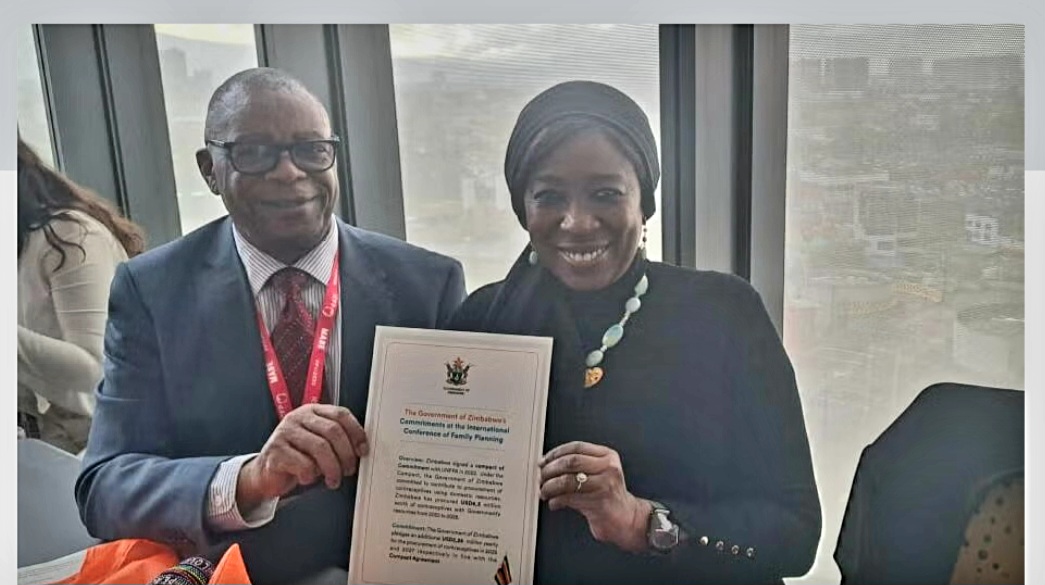

Minister of Health and Child Care Dr Douglas Mombeshora and UNFPA Executive Director Ms Diene Keita display the Government of Zimbabwe’s commitment at the ICPF 2025
BY MUNYARADZI BLESSING DOMA
As traditional global aid for reproductive health declines, Zimbabwe announced its own bold investment to safeguard access to family planning for women and girls nationwide.
The commitment was announced at the International Conference on Family Planning in Bogotá, Colombia, during a high-level session co-hosted by UNFPA, the United Nations Population Fund and FP2030.
Zimbabwe pledged an additional US$2.25 million yearly for the procurement of contraceptives in 2026 and 2027.
“The Government of Zimbabwe remains steadfast in its commitment to the health and well-being of our citizens,” said Dr Douglas Mombeshora, Minister of Health and Child Care.
“Our continued investment is a testament of our commitment under the 2023 Compact with UNFPA.
“Having already procured US$6.3 million worth of contraceptives from domestic resources since 2022, this new pledge ensures that we continue to safeguard the reproductive health of our communities,” added Minister Mombeshora.
Through its flagship global health initiative, the UNFPA Supplies Partnership, UNFPA strengthens national supply chains, policy frameworks and accountability systems in 54 countries. Through incentives such as its Match Fund – which provides US$2 for every US$1 a country invests –up to US$2 million, government spending on contraceptives has increased fivefold since 2020, reaching a record US$52 million in 2024.
The new investment by Zimbabwe exemplifies an emerging model of nationally driven progress built on political will and partnership.
“Governments are putting family planning at the heart of national development, and UNFPA is proud to stand with them. When women can plan their pregnancies, countries can plan their futures. Every national pledge made today is a promise to women and girls — that their health, rights and choices matter,” said Diene Keita, Executive Director of UNFPA.
Each dollar invested in family planning yields nearly US$27 in health and economic returns, making it one of the smartest investments a country like Zimbabwe can make. Following Zimbabwe’s lead, governments, the private sector, civil society and multilateral institutions must continue working together to close funding gaps and make reproductive choice a universal reality. This is the foundation of a healthier, more equitable and prosperous world.