


BY MUNYARADZI BLESSING DOMA
It’s around 2pm and Chenai (not her real name), is sitting under a big mango tree which is at the centre of her Seke rural home.
The plate of sadza in-front of her is untouched, and Chenai is unfazed by the presence of the family dogs which are circling around her, in a bid to snatch the food away.
One can tell that something is amiss, because despite several calls from her mother, Chenai remains silent, looking in the distance.
Her mother had to throw a twig at her, as she advised Chenai that her friends were approaching their homestead.
When Chenai dropped out of school, her four friends never stopped visiting her and most times, they would share with her, their day’s lessons.
Economic hardships had led Chenai to drop out of school because her mother, who had a disability, had lost all her savings from a failed horticultural project.
Chenai’s friends were excited with the topic they had been learning, such that they had decided to share with her.
The four girls told their friend that under Guidance and Counselling, they had been learning about Comprehensive Sexuality Education (CSE), which had a lot of issues, including reproductive health.
Chenai felt the topic was taboo, such that as the girls started telling her about several aspects of the subject, she asked them to speak nomore, revealing that any discussion that involved anything related to sexuality or reproductive health, was banned in their compound.
But one of the girls had to advise Chenai that CSE was meant to help them develop better in various aspects of life, using accurate information.
Afted dropping out of school, Chenai missed quite a lot, one of which being CSE which her peers were better informed of.
And with rising cases of teenage pregnancies, HIV infections and Sexually Transmitted Infections (STIs), among other vices affecting adolescent girls and young women, Chenai was at a serious risk as she didn’t have the knowledge to deal with such issues.
According to the World Health Organisation (WHO): “Comprehensive Sexuality Education (CSE) gives young people accurate, age-appropriate information about sexuality and their sexual and reproductive health, which is critical for their health and survival.”
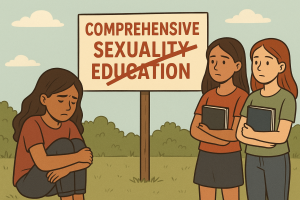
However it has been noticed that while in Zimbabwe CSE has helped many in school young people, those of out school are being left behind.
And according to the International Technical and Programmatic Guidance on Out-Of-School Comprehensive Sexuality Education published by the UNFPA along with other contributing partners, “CSE is vital to advancing health outcomes and gender equality.
“It gives young people tools they need to have healthy lives and relationships, and helps them navigate changing decisions about their sexual and reproductive health.”
It is added that out-of-school CSE is CSE delivered outside the school curriculum.
“Out-of-school CSE can provide CSE to children and young people in situations where CSE is not included in the school curriculum.
“Provide CSE to children and young people who are not in school.”
Chenai is among the many girls who have lost out on vital information that can help them become better individuals.
While those in school are getting CSE through their Guidance and Counselling, which aims to empower them with correct knowledge, attitudes, skills and values to make informed sexual and reproductive health choices, the same cannot be said for Chenai.
In Zimbabwe, CSE aims to equip young people with knowledge and skills necessary to make informed decisions about their sexual reproductive health (SRH), address critical issues such as teenage pregnancies and STIs.
With several challenges facing out of school young people, a CSE Curriculum manual was designed by several stakeholders, with the aim of focusing on out of school youths in communities teaching them about sexuality, reproductive health, gender, rights, services and related life skills aligned to the National Adolescent and Youth Sexual and Reproductive Health (ASRH) strategy II 2016-2020.
The aim is to bring out of school youths together through facilitating group meetings. “These group meetings provide an environment for open dialogue and communication on issues affecting youth today; the growing numbers of teenage pregnancies, school dropouts, drug abuse, social, sexual and reproductive health problems, sexual gender based violence, STIs and HIV.
“The group meetings will provide a social support network within their own community that is likely to extend beyond the lifespan of their group,” read the CSE Curriculum manual.
It is said that the curriculum is designed to help youth in Zimbabwe “face the challenges of growing up, developing positive relationships, protecting their sexual and reproductive health, and working to improve the situation of young people in their own communities.
“The challenges affecting youth today are all too visible: the growing numbers of teenage pregnancies, school dropouts, alcohol and substance abuse, and social, sexual and reproductive health problems, like date rape, STIs and HIV and AIDS, are all indicators that many youths are simply unable to cope.
“Youth leaders can help young people by providing them with correct information, challenging them to look at their own attitudes and behaviours, and helping them to develop the skills they need to adopt healthy behaviours and to stay safe now and in the future.
“For young men and women, adolescence and youth is a time filled with excitement, new feelings, unanswered questions, challenges, changes and difficult choices,” added the manual.
It was further revealed that young out-of-school people need to know the facts about their own sexuality, plan for happy futures and healthy lives, and begin preparing for the world of work.
The CSE Curriculum focuses on three important issues which young people face; recognizing the importance of adhering to their own values; learning more about how their bodies function and dealing with sexual and reproductive changes, feelings and behaviours; and thinking about and planning for their future.
“Comprehensive Sexuality Education helps young people find out who they are now, where they are heading, who they hope to become, and how to get to where they want to be.
“Comprehensive Sexuality Education provides many activities that facilitators can use to help young people to: gain information about themselves and their sexuality; how to prevent pregnancy and avoid sexually transmitted infections and HIV, and to learn more about preparing for the world of work; look at their attitudes and feelings about growing up, gender roles, risk taking, sexual behaviour and relationships; and practise making decisions, setting goals, communicating clearly, negotiating to protect their own health, and resisting negative peer pressure.”
The main objectives of the manual are to provide out-of-school youth with a chance to: “learn more about themselves, how they feel about sexuality and relationships; what their personal values are; what is happening to their bodies and emotions; what influences their developing feelings and choices; and how gender roles and stereotypes affect them.
“Identify what they want to happen in their lives; figure out how to work towards building good futures by planning and setting goals; and develop their understanding of relationships and their communication skills.
“Acquire accurate knowledge about human sexuality, human rights and gender; how to protect their sexual and reproductive health, and how to reduce sexual and gender-based violence.”
Maxwell Changombe, Programmes Coordinator at Restless Development said whilst the government should be applauded for implementing Comprehensive Sexuality Education in schools, more needs to be done to include access for those young people who are out-of-school.
Changombe said it was commendable that deliberate efforts had been made to ensure CSE is being taught in teacher-learner institutions and also in nurse training institutions.
“We really implore the government to ensure that they really enforce the implementation of Comprehensive Sexuality Education in schools, where it’s been structured as guidance and counselling, and we really applaud that.
“But however, there is a lack in out-of-school young people, those who are not school-going, they really lack access to Comprehensive Sexuality Education.
“We acknowledge that it’s being done in different health clubs, by different non-governmental organizations, clinics, however, the consistency is not there,” said Changombe.
Changombe added that in other settings that are not schools, the quality is not monitored to check if those young people are receiving CSE.
“And another issue is those who are in hard-to-reach areas, in remote areas, they don’t have access to this Comprehensive Sexuality Education.
“So there’s need for government to ensure there are youth-friendly health services, there are youth centres in hard-to-reach communities where young people can easily access Comprehensive Sexuality Education.
“There are teenage pregnancies that are happening, early marriages, gender-based violence, substance and drug abuse.
“These can be combated with this kind of education given to young people, because they can help them to grow and knowing fully what they can anticipate in life.
“Because CSE is not about health education, but it also incorporates life skills education, where a young person is taught on career guidance, is taught on how they can set their goals going forward.”
Changombe however added that compared to other countries, Zimbabwe is doing well in terms of implementing CSE, especially in schools where it’s structured.
He reiterated that the other important part is that CSE encourages young people to self-care.
And he further stated that CSE can be taught at any age, but it will be age-appropriate, where a young person is given information that is appropriate for their needs.
“So you find a young person at ECD (Early Childhood Development) A, ECD B being taught CSE, but it’s appropriate to their age.
“It also goes to those who are at puberty level, they are also given age-appropriate CSE.
“So there are young adolescents, they are given information that relates to them and early adolescents are also given information related to them.
“Late adolescents are also given information that relates to them, so CSE can be given to anyone, however it should be age-appropriate,” he added.
The International Technical and Programmatic Guidance on Out-Of-School Comprehensive Sexuality Education further reports “that out-of-school CSE is important because UNESCO estimates that globally, 263 million children are out of school, including 63 million children of primary age, 61 million of lower secondary-school age, 139 million of upper-secondary age (ISU, 2018).”
“It gives young people tools they need to have healthy lives and relationships, and helps them navigate changing decisions about their sexual and reproductive health.”
It is added that out-of-school CSE affords the opportunity to create a more informal flexible setting than may be possible in school, with the potential for smaller learning groups, longer class times, more varied and creative delivery of the curriculum, and more interaction among learners.
“It can bring together children and young people with similar life experiences or living in the same context, especially those who are marginalized, provide them with CSE tailored to their specific needs, and encourage them to act as support networks for each other,” added the report.
According to a report by Restless Development tilted “Enhancing access to SRHR services and information for young people”, the lack of high quality sexual and reproductive health services and education in Zimbabwe has meant high rates of HIV and other STIs and teenage pregnancy.
The report added that while Zimbabwe has announced the implementation of comprehensive sexuality education, there is no realistic plan to reach out to groups of young people with different vulnerabilities.
While there is growing acknowledgment of the importance of CSE, it is unfortunate that thousands of out-of-school children and young people are not having access to vital information that can help protect, empower and guide them.
And the goal now is to reach every child and young person, no matter where they are, recognising that their knowledge is not a privilege but a right.


