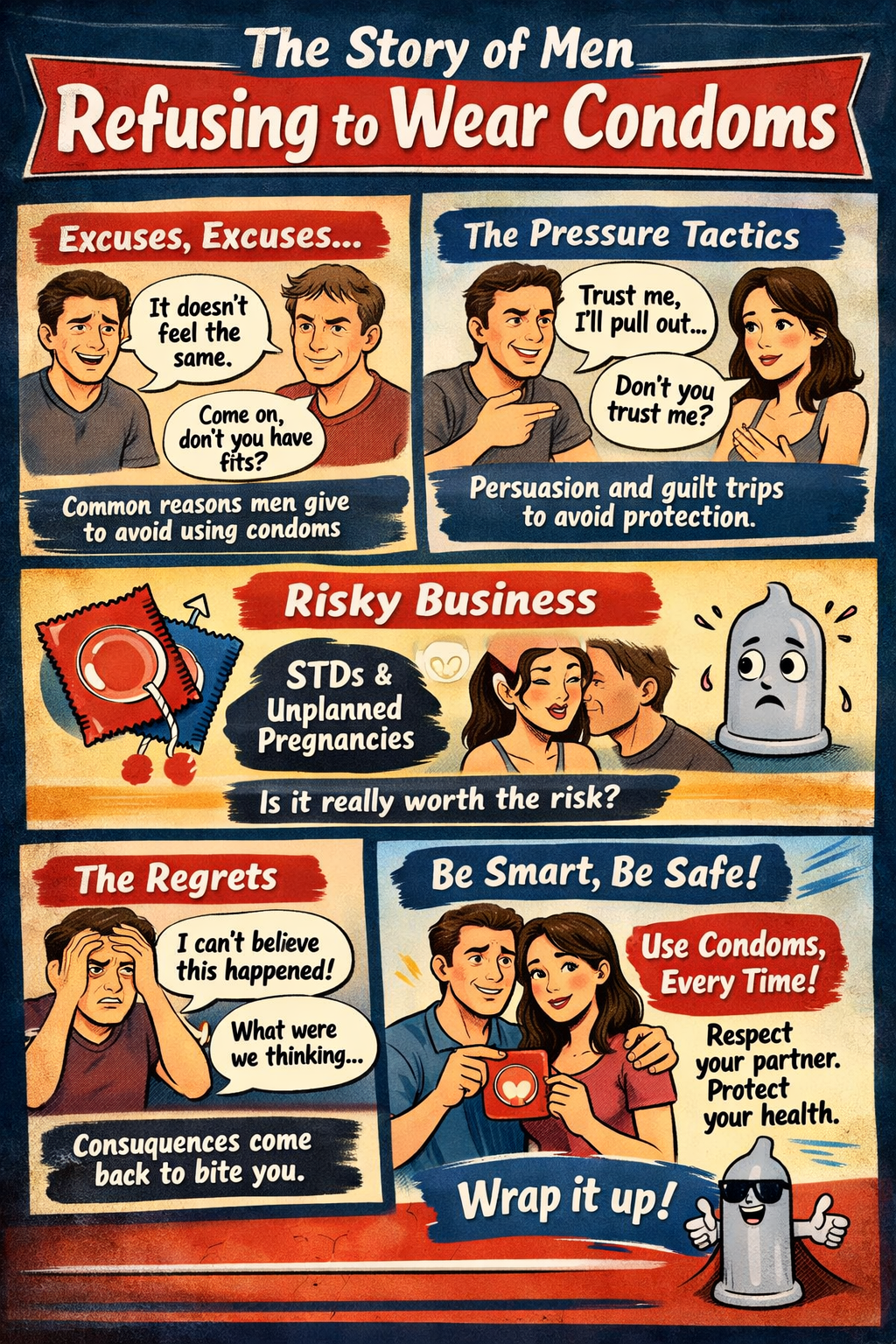
illustration of key messaging around men’s refusal to wear condoms
BY MUNYARADZI BLESSING DOMA
Despite years of public health campaigns promoting safe sex, condom resistance among some men continues to undermine efforts to reduce HIV infections in Zimbabwe.
While health personnel continue to promote condom use, advising that they (condoms) remain one of the most effective methods of preventing HIV and other sexually transmitted infections (STIs), some men still prefer not to use them.
Many reasons are given, some argue they (condoms) delay ejaculation while some argue they reduce sexual pleasure.
And despite all the risks, some just decide not to use them.
Some men in Gokwe revealed their dislike for rubber as it were, during a National AIDS Council (NAC) tour of Midlands Province.
While some decided to be anonymous about their dislike, one man left people in stitches as he revealed why he does not like wearing a condom.
While many laughed, it was no laughing matter, as his sentiments revealed a deep issue which needs to be seriously looked at, because whilst condoms may be available, many are not being used.
Village Head Sorobi Sikati speaks of his dislike for condoms
“You cannot expect me to wear a condom when I’m with my wife.
“And maybe when I’m with a sex worker I may need to wear one, but then again, I need to enjoy the sexual act because I would have paid my hard earned money.
“So I won’t wear it, because sex with a condom is not good, hazvitaste.”
According to NAC, consistent and correct condom use significantly lowers the risk of HIV transmission.
But yet on the ground, cultural norms, misinformation and power imbalances are weakening that protective shield.
And as the man spoke, it was also evident that for many women, asking a partner to use a condom can spark conflict.
“I think you heard for yourselves, we will continue to have HIV because the men despite having many sexual partners, will always refuse to wear a condom.
“Tongoramba tichigwara nekuti varume vacho havabviri (HIV will always be there because depsite being promiscuous, the men refuse to wear condoms),” said one who pleased for anonymity.
During the meeting, some men revealed that the request of a condom from a partner, especially a wife, is a sign of mistrust or infidelity which cannot be tolerated.
In Gokwe South, gender norms are also a major factor, as it was evident that masculinity is wrongly equated with sexual dominance and risk-taking behaviour.
And some men further revealed anonymously that negotiating condom use is viewed as challenging male authority.
The World Health Organization (WHO) maintains that condoms are safe, effective and essential in preventing HIV and other sexually transmitted infections when used correctly.
While the country has made great strides in reducing HIV prevalence over the years, some health experts warn that inconsistent condom use threatens to reverse those gains.
In most cases, the Ministry of Health and Child Care and other partners, distribute free male and female condoms nationwide, but as evident from that meeting, availability alone does not guarantee usage.

Nomatter Kamudande, local nurse
During the community dialogue which was led by Nomatter Kamudande a local nurse, she revealed that there was need for more male-focused engagement programmes, initiatives that challenge harmful masculinity norms and encourage shared responsibility in sexual health.
She further revealed that creating more community dialogues can go a long way in health education as the country moves forward with the goal of ending AIDS by 2030.