

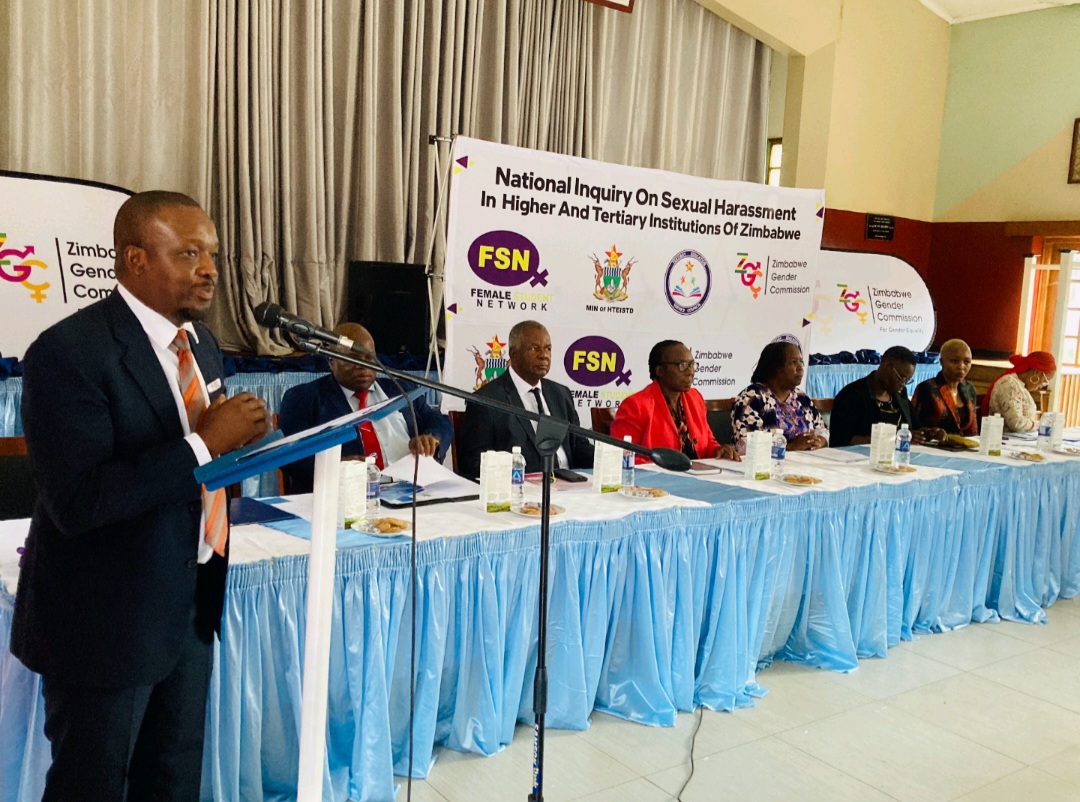
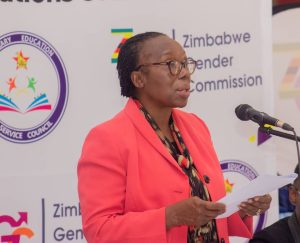
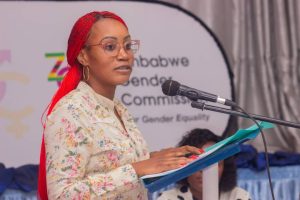
ZGC Chairperson, Commissioner Margaret Mukahanana-Sangarwe (pic by Daphne Machiri)
BY MUNYARADZI BLESSING DOMA
Since the established of the Zimbabwe Gender Commission (ZGC) in 2015, sexual harassment in higher and tertiary institutions, constitute the majority of cases received, Chairperson Commissioner Margaret Mukahanana-Sangarwe has said.
Commissioner Mukahanana-Sangarwe revealed this today (Thursday) at the launch of the National Inquiry on Sexual Harassment in Higher and Tertiary Institutions.
The launch which was held at Harare Polytechnic College, was attended by several stakeholders including students.
“Since our establishment, the Commission has received a wide range of cases in which sexual harassment cases constituted most cases.
“Among the sexual harassment cases dealt with, sexual harassment cases in tertiary institutions constituted the majority,” said Commissioner Mukahanana-Sangarwe.
She added: “as we gather here, we do so against the backdrop of a deeply concerning reality: the rising number of complaints related to sexual harassment within our tertiary institutions.
“The Zimbabwe Gender Commission has seen a significant increase in reports from individuals who have bravely come forward to share their experiences. These stories are not just numbers; they are voices pleading for recognition, justice, and change. Each report represents a life disrupted, a future jeopardized, and a community that has been let down.”
Commissioner Mukahanana-Sangarwe also revealed that as a result of the alarming trend, the Ministry of Women Affairs Community, Small and Medium Enterprise Development, on the 2nd of October 2020, had formally requested them to conduct an Inquiry into the prevalence and impact of sexual harassment in the educational institutions.
“The Commission launched some initiatives such as awareness raising, research and surveys to establish whether sexual harassment is really a problem in tertiary institutions.
“It is through the various initiatives undertaken that provides baseline on gaps and issues of sexual harassment in tertiary institutions.”
She added that the launch of the National Inquiry marks a crucial milestone in the collective commitment to ensuring safe and dignified educational environments for all students and staff within the higher education sector.
Commissioner Mukahanana-Sangarwe added that the ZGC was conducting the Inquiry as a crucial step towards upholding gender equality and ensuring a safe and conducive learning and working environment for all.
“This Inquiry is mandated by the ZGC’s constitutional and statutory obligations. “Section 246 of the Constitution of Zimbabwe mandates the ZGC to safeguard gender equality and protect victims of abuse.
“Section 5 of the Zimbabwe Gender Commission Act [Chapter 10:31] empowers the ZGC to investigate any systemic barrier prejudicial to gender equality, gender equity or gender mainstreaming in a specific named sphere of activity or named sector of the society or economy.
“This Inquiry aligns perfectly with our legal obligations and our mission to promote gender equality across all spheres of society.
“By examining the systemic factors contributing to sexual harassment in Higher and Tertiary institutions, we aim to identify and address the root causes of this pervasive issue.
“Our investigation will shed light on how institutional cultures, policies, and practices may inadvertently perpetuate environments where harassment can thrive.
“This proactive approach is crucial for fostering long-term change and ensuring that our educational institutions are not only safe but also equitable. This Inquiry is not merely a procedural response; it is a necessary step toward understanding the depth of the issue and developing informed strategies to address it,” she added.
She also revealed that the previous findings and reports, including a 2022 Parliamentary Committee Report, indicated widespread allegations of sexual harassment and highlighted systemic issues such as power imbalances within institutions that enable exploitation.
Commissioner Mukahanana-Sangarwe added that the National Inquiry aims to: “collect data on the prevalence and nature of sexual harassment in Higher and Tertiary institutions.
“Understand the institutional responses to reported cases. Identify gaps in policies and implementation.
“Promote a safe and conducive learning environment for all students and staff.”
And she added that primary objectives of the National Inquiry are: “to determine the extent and types of sexual harassment occurring in tertiary institutions across Zimbabwe.
“To analyse how institutions handle reported cases, including support mechanisms for victims.
“To uncover the barriers that prevent victims from reporting harassment and accessing support.
“To propose actionable recommendations for policy reforms and improved policy implementation by all institutions.”
She added that the ZGC also acknowledges the commendable efforts of the Ministry of Higher and Tertiary Education in developing a Model Sexual Harassment Policy for all institutions in Zimbabwe.
Commissioner Mukahanana-Sangarwe said this initiative is a significant proactive measure that sets a clear standard for addressing and preventing sexual harassment across the educational landscape.
“The Model Policy serves as a framework for institutions to implement effective measures that protect students and staff, ensuring that everyone can pursue their academic and professional goals without the threat of harassment.
“By providing guidance on best practices and procedures for reporting incidents, this policy complements our inquiry and reinforces our collective commitment to fostering safe educational environments,” added Commissioner Mukahanana-Sangarwe.
She further revealed that the inquiry is just the beginning, as it is a stepping stone towards a broader commitment to eradicating sexual harassment from the country’s institutions.
“Education is meant to empower, inspire, and uplift. It is unacceptable that our institutions, which should be sanctuaries of learning and growth, have become places where harassment undermines this mission.”
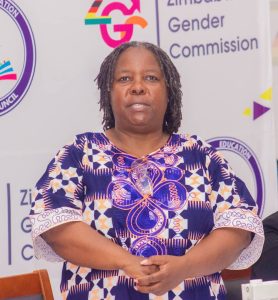
ZGC CEO, Virginia Muwanigwa (pic by Daphne Machiri)
Virginia Muwanigwa, ZGC Chief Executive Officer, speaking at the same event said the National Inquiry was a critical and long-overdue initiative.
“We are gathered here not merely for a launch, but for a declaration. A declaration that the halls of learning, which should be sanctuaries of intellectual pursuit and personal growth, must no longer be shadowed by the scourge of sexual harassment.
“We declare today that the era of silence, impunity, and suffering is over.
“We have heard the whispers in corridors, the distressing stories shared in confidence, and the brave voices that have broken the silence on social media and in courtrooms.
“We have seen the devastating impact: brilliant young minds dropping out of college, promising careers shattered, and deep psychological scars that last a lifetime.
“This is not just a violation of personal dignity; it is an assault on our national potential. It is a barrier to our collective development, and we can no longer afford to ignore it.”
Muwanigwa added that the “Inquiry will be thorough, and victim centred.”
She also said that ZGC will create safe and confidential channels for students, past and present, as well as staff, to share their experiences.
And ZGC will also engage with university leadership, staff unions, student bodies, security officials, and all relevant stakeholders.
“Our approach will be empathetic, fair, and impartial. It is also important to note that this process is not a witch-hunt, but a collaborative effort to support you in fostering environments where every student and lecturer can thrive without fear. “Protecting your institution’s reputation begins with rooting out injustice, not hiding it.
“This launch is not the end, but the beginning. The real work starts now.
“The findings of this Inquiry will lead to a definitive report with bold recommendations, which we will present to Parliament and the nation.
“We will not let this report gather dust on a shelf. We will be relentless in our follow-up to ensure implementation.
“Let us be remembered as the generation that dared to confront this uncomfortable truth. Let us be the architects of a new culture -a culture of respect, zero tolerance, and equality in our places of learning.”
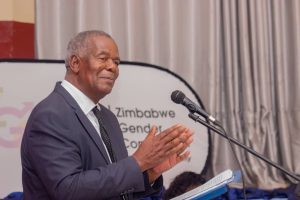
Vice Chairperson of ZGC, Commissioner Obert Matshalaga (pic by Daphne Machiri)
Vice Chairperson of ZGC, Commissioner Obert Matshalaga said the launch was not just about naming the problem of sexual harassment; but it was about affirming the shared value that every student and educator in Zimbabwe has the right to learn, to teach, and to grow in an environment of safety, dignity, and respect.
“The journey we begin today will require courage, persistence, and unwavering commitment. The path of truth-seeking is often difficult, but it is the only path that leads to justice and healing.
“The Zimbabwe Gender Commission is prepared to walk this path, and we are immensely grateful that so many of you have pledged to walk it with us.
“Let us leave here today with a clear understanding of our individual and collective responsibilities: to listen to survivors with empathy and belief, to participate in this Inquiry with honesty and courage, to support the process through cooperation and the provision of information, and to ultimately act on the findings to create tangible, lasting change.”
Some representatives of different institutions gave solidarity remarks as the need for proper collaborations so as to eliminate the scourge of sexual harassment in higher and tertiary institutions was emphasised.
Solidarity remarks
Ministry of Higher and Tertiary Education, Innovation, Science and Technology
We commend the Commission for this critical and timely action. This initiative marks a significant step towards addressing one of the most urgent social challenges affecting our living in Zimbabwe.
By participating in and supporting this inquiry, institutions will benefit in several important ways. First, but not by order, the data and findings will provide complete evidence-based guidance to help institutions strengthen their internal policies and prevention mechanisms. Secondly, institutions that engage actively with the Commission will gain capacity-building opportunities, technical support and best practice models for managing harassment cases.
Finally, collaborating with the ZGC enhances institutional credibility and demonstrates a true commitment to upholding dignity, equality and human rights on campus.
For the Ministry, the findings will also help evaluate the effectiveness of current policies. We fully support the Zimbabwe Gender Commission in this National Inquiry and urge all institutions to actively participate and partner with the Commission, not only for compliance but as a pathway to meaningful institutional transformation.
Ministry of Women Affairs, Community, Small and Medium Enterprises Development
I believe this is not an ordinary launch of the Inquiry, but it is symbolic of our shared commitment towards ending sexual harassment in our social institutions.
As we participate in this launch, we are also standing in solidarity with the survivors of sexual harassment who oftentimes have not been able to express their feelings, to express their experiences, but have remained silent, and now it is time for them to be recognised and remembered.
It is testament of your genuine concern and acknowledgement that there are challenges in our social institutions, and that acknowledgement is the first step towards the commitment to resolve the problem.
Sexual harassment goes beyond the general abuse. It is a systemic issue that resides in power imbalances, and it undermines the dignity, self-esteem and full satisfaction of students in their education, thereby negatively affecting their future.
The Ministry remains committed to ending sexual violence and gender-based violence in all its forms and at every level.
We shall continue to raise awareness through various platforms to ensure that everyone is aware of the ills of gender-based violence.
Additionally, we are available also to support the social institutions in the fight against sexual and gender-based violence.
We are also committed to making the law work for everyone, and we continue to ask for a constrained implementation of laws on sexual harassment and gender-based violence, ensuring that survivors get the services they need, and that perpetrators are held to account for their actions.
As this inquiry is set to start, it is also an opportunity for those that have been silenced to tell their story and experiences and to be heard. We look forward to the findings of this inquiry and the great opportunity that it will help us influence our policies and programmes. As a Ministry, we stand in solidarity with you, SGBV, and we look forward to this great work that you have embarked on, that it will also improve the lives of every girl and boy in this country.
Women’s Coalition of Zimbabwe (WCOZ)
We are here to offer our unwavering support and solidarity for this crucial National Inquiry on sexual harassment in tertiary institutions. This collaboration between the Zimbabwe Gender Commission and the Female Students Network is a monumental and marching step forward for our country.
For years, women, including young women in tertiary institutions, have been at the forefront of the fight against gender-based violence in all forms. We have seen first-hand, the devastating impact that sexual harassment has on women and girls, not just in their personal lives, but in their ability to access education, secure employment, and thrive in the society.
In our advocacy efforts, we have constantly highlighted the need for comprehensive and enforced policies to protect women in all spaces, including learning institutions. This National Inquiry is a powerful statement. It is an acknowledgement that our tertiary institutions, which should be sanctuaries of learning and innovation, have instead become spaces of fear and vulnerability for many of our students. The data is clear and very chilling. Research by the Female Students Network has shown the alarming prevalence of sexual harassment and a recent Parliamentary probe unearthed rampant abuse fuelled by issues like the absence of clear policies and the transactional demand placed on students.
This inquiry promises to shed light on these dark corners and provide a roadmap for everlasting change.
We must ensure that these findings lead to the strengthening of institutional policies, the establishment of accessible and confidential reporting mechanisms and the provision of social cycle support for survivors.
Let us work together to build a Zimbabwe where every young woman can pursue her education free from fear with her dignity intact.
Kimberley Nyatanga, Female Students Network Board Chair (pic by Daphne Machiri)
As Female Students Network, we are very excited that our government is making strides in making sure that things start moving, things start happening in order to have safe spaces in tertiary institutions. So as the Female Students Network, we are proud to stand not only in solidarity, but as a strategic partner of the Zimbabwe Gender Commission.
Sexual harassment remains a pervasive and deeply harmful reality across Zimbabwe’s higher and tertiary education sector.
For too long, survivors have been silenced by stigma, by fear, institutional inertia. This inquiry marks a decisive shift. And that is a national commitment to truth-telling. That’s for starters. Second one, accountability for each and every person and survivor-centred transformation.
As partners in this process, FSN recognises the Inquiry as a vital tool to document the prevalence and current patterns of sexual harassment across institutions of higher learning in Zimbabwe. Identify high-risk environments and guide targeted interventions. Amplify the implementation of the anti-sexual harassment policy introduced by the Ministry of Higher and Tertiary Education, Innovation, Science and Technology Development from an informed point of view.
There is also a pledge to complement our government’s efforts in promoting gender equality in Zimbabwe in general. So this inquiry will not only inform policy and legislative reform, but it will also strengthen institutional cultures of care, safety and dignity. Thereby promoting a conducive learning environment for all; that includes the male students as well.
This Inquiry has been strategically timed as it comes upon the realisation that the context has evolved. Therefore, it is of paramount importance to catch up with the current lived realities with the higher and tertiary institutions.


